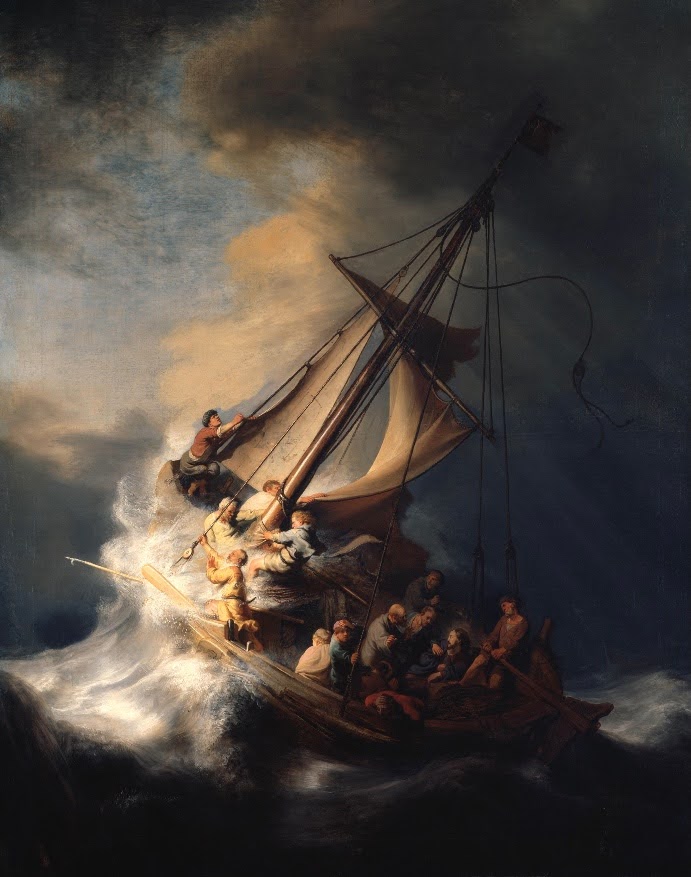
Thursday, April 22, 2021
In the Storm with Jesus
Friday, March 26, 2021
A New Opportunity
In its nearly 20 years of existence, AmblesideOnline has never charged for its online curriculum or forum. Our entire offering has been and will always be free.
We have been able to pay for our work through Amazon's Affiliate program, but we now have an opportunity to provide an additional way to support AO.
Monday, March 15, 2021
Equipping the Power
by Anne White
Charlotte’s primary-level students narrated a little at a time, to fully develop their powers of attention and their skill in telling back.
“[Attention] is the power of bending such powers as one has to the work in hand; it is a key to success within the reach of every one, but the skill to turn it comes of training.” (Formation of Character, p. 95)
They used the
same stories for “telling back” as they did for other subjects, from mythology,
fairy tales, The Pilgrim’s Progress, and the Bible; and they told about “how
we know the world is round and a great deal besides; for all their work lends
itself to oral composition and the power of such composition is innate in
children and is not the result of instruction” (Philosophy, p. 191).
Does that contradict what Charlotte said in Formation of Character? No,
it is the attention, or the listening ear, that must be trained; but the power
to tell (aside from a few basic instructions in what is expected) is a natural
one.
The junior grades “wrote their
little essays themselves.” “Little” seems to refer only to length, because oh
my, the reading list... “We could do anything with books like those,” said an
unnamed headmaster. Charlotte scolded him for missing the point, but I think he
was at least half right: the ability to narrate well, and to turn that skill
into written composition, does begin with the choice of books. Some writers can
start from a point inside their heads, without any outside reference, but for
most of us, that’s as hard as being handed a brush and told to paint, without
having anything to look at. “Compose something,” my piano teacher once
commanded, when I was about ten. But since I knew very little about listening
to music, much less about creating it, the result was worthless, a waste of
time. I knew my way around the piano keyboard, but I had no musical ideas, nothing
to write music about; I did not understand even how to begin with the “major
lines,” much less work out the details. And she never asked me to do that
again. Why, similarly, do teachers ask children to shape composition bricks,
but refuse to give them the right mud for the task, never mind straw?
"For right thinking is by no means a matter of self-expression. Right thought flows upon the stimulus of an idea, and ideas are stored as we have seen in books and pictures and the lives of men and nations; these instruct the conscience and stimulate the will, and man or child ‘chooses.’" (Philosophy, p. 130)
Excerpted from Ideas Freely Sown: The Matter and Method of Charlotte Mason, by Anne E. White
Thursday, February 25, 2021
Networking
by Anne White
Education theorists talk about the recognition, strategic, and affective networks of the brain. The recognition network is how you process information, including your receptive skills. The strategic network is how you respond to information and express what you have learned. The third is the affective network, which has to do with how you personally engage with what you’re learning.
What are the most important
things you can think of in a Charlotte Mason education? “Living ideas?” We get
some of these seeds of inspiration from books or from oral teaching, but they
are also a part of our everyday explorations. So for that, we access the recognition network. “Narration?” Probably the strategic network. “Children
are born persons.” What does it mean for us to remember that grownups are born
persons too? We listen to each other; we acknowledge that we have different
points of view; but we try to work together to achieve shared goals and build
community. You could say that that requires all three of our neural networks.
“Masterly inactivity?” This
relates closely to “born persons,” by allowing learners to make their own
connections and take responsibility for their own learning. One of my education
textbooks says that the affective network
determines “whether or not an individual finds what is being taught to be
important, interesting, and worthy of attention or action.” In other words, “does he care?”
What about “Education is the
science of relations?” The relationships we build with the world, and with
others are also building us; and we don’t stop building just because our
children no longer need us to do math with them. Again, I think, all the
networks.
One of the things that researchers are getting better at all the time is admitting how complex our
brains are when it comes to learning. Back in the era when doctors started
doing lobotomies, they thought it was a genius idea because they had perfectly
mapped out (they thought) how the different parts of the brain were supposed to
work and what they were supposed to do, and they didn’t see how one little
change could affect the other functions. But we now know that it’s very hard to
draw a permanent you-are-here map of what connects with what. Things change
around, and functions are shared. The limbic system of the brain used to be
associated with emotions, but neuroscientists now see it as more of a very
complex communications center, and it’s responsible for a great deal of
learning and memory. What that means for us is that if we engage with
information in a way that stimulates us emotionally, for instance through a
story, we are more likely to retain it.
Tuesday, February 16, 2021
Charlotte Mason and the "Kindergarten Problem"
by Anne White
After that introduction, Charlotte goes on the warpath against Froebelian kindergartens, which were soaring in popularity at the time. Those of us who attended North American kindergartens in the late twentieth century might not quite understand her objections; we might think of singing along with the teacher’s autoharp (or boom-box), or of playing at the sand table, or painting with drippy paints at an easel; and of the whole thing being rather fun, at least in comparison to the higher grades; but the early kindergartens were not quite like that. Children were led through programmed activities involving boxes of geometric shapes, and other materials such as “folded paper and woven straw.” Sometimes they sat at little tables, sometimes they stood in circles and moved as prescribed (think of the actions for “I’m a Little Teapot”). (If you really want to know more about the purposes and methods of kindergartens at that time, see if you can find a copy of Norman Brosterman’s book Inventing Kindergarten.) When Charlotte Mason quotes Anne Sullivan as requesting not to be sent any more kindergarten materials for Helen Keller, she is rebelling not so much against the nice craft supplies as against the ways that they are supposed to be used.
“I am beginning to suspect all elaborate and special systems of education. They seem to me to be built up on the supposition that every child is a kind of idiot who must be taught to think, whereas if the child is left to himself he will think more and better, if less showily.” (Anne Sullivan, quoted in Home Education, pp. 195-196)
There was one more twist to the “kindergarten problem,” and that is that Froebel (like Pestalozzi before him) was undoubtedly a genius, with a deep desire to pass on his vision of the universe. A child who played with his wooden cubes, and made designs with toothpicks and dried peas, might have ended up with, at least, an amazing sense of artistic design. (Frank Lloyd Wright was apparently one of those.) But Froebel had died in 1852, when Charlotte Mason was ten years old; and by the era of Home Education thirty-plus years later, his own writings (dense and difficult) were skipped over by busy young teachers. His methods had been adapted and restyled; the activities were kept, but the understanding was lost. The kindergartens of Charlotte’s time might be called merely Froebel-ish.
And that is the context in which she
wrote,
“…[if a child participates in too-structured early learning],during the first six or seven years in which he might have become intimately acquainted with the properties and history of every natural object within his reach, he…can distinguish a rhomboid from a pentagon, a primary from a secondary colour, has learned to see so truly that he can copy what he sees in folded paper or woven straw,—but this at the expense of much of that real knowledge of the external world which at no time of his life will he be so fitted to acquire.” (Home Education, p. 179)
The early-years
curriculum described here is one which produces skillful hand-eye co-ordination,
and also teaches children to think “showily,” to quote Anne Sullivan; but which
misses out on heart. It is the equivalent of learning scales without music, or
capitals of the world without people. It might even be read as an echo of St.
Paul’s “If I do this or that good thing, but have not love, I am nothing.”
Ironically, those who recommend
such a structured program (or its contemporary equivalent) might say that they are,
in fact, providing “real knowledge of the external world,” perhaps in the same
way that Eustace Scrubb was raised to enjoy pictures of grain elevators.
Charlotte Mason, on the other hand, describes fortunate children whose early
years allowed them to become “intimately acquainted with the properties and
history of every natural object within [their] reach”; whose parents realized
that they could pick up most of the common shapes-colours-numbers lessons
simply by living, working, and playing. Playing included playing outdoors, as
often as possible, and not only on playground equipment, or at soccer practice,
but by climbing (trees, preferably), touching, digging, splashing in creeks or
at the shore, listening, looking; particularly looking. “The child’s
observation should be directed to flower or boulder, bird or tree; that, in
fact, he should be employed in gathering the common information which is the
basis of scientific knowledge” (p. 177). The goal is, like that of the
kindergarten, to teach children to “see so truly”; but the eyes are focused
here not on rhomboids and weaving straws, but on objects which will be theirs
for a lifetime.
Excerpt from Ideas Freely Sown: The Matter and Method of Charlotte Mason, by Anne E. White (to be published soon)
Wednesday, August 19, 2020
Setting Yearly Goals for Written Narration
by Karen Glass
I did write extensively about the whole process of learning to write through written narrations in Know and Tell, but that big picture has to be broken down into individual school years, and semesters or terms, and—of course—individual weeks. What will we do about written narrations this year? What do I need to do this week?
I’m going to try to break this down into steps that you can use to evaluate your student, set realistic goals, and create a plan that will allow your child to make progress this school year—just this school year—without worrying too much about the Whole Thing. I’m assuming you understand the purpose of oral and written narration, and that you desire to make narration the foundation for a significant portion of your child’s writing instruction (there’s room for some outside resources, but that’s not what this is about). Let’s figure this out.
Okay, the first thing you need to think about is what your child is doing right now. What was the norm when you left off at the end of last school year? If you’re just getting started, the obvious place to begin is at the beginning, with one written narration per week. But maybe you’ve already been doing written narrations, and last year your child was doing two per week, or three. That’s where you start now. For the first four to six weeks of this school year, just let your child get back into the rhythm of doing what he already knows how to do. Don’t ask for anything else just yet.
As you think about this—where your child is with written narrations—there are two things to think about—how frequently the written narrations are done, and how long they are. As children make the transition from oral to written narrations, the earliest written narrations may be much, much shorter than oral narrations. Don’t worry about that. Some children can just barely write a sentence or two when they begin, while others are ready to write multiple paragraphs. No matter what your child is doing when you begin written narrations, accept what they can do.
What I never said plainly in Know and Tell, but wish I had, is that it is better to increase the frequency of written narrations first, and then work on asking for longer narrations. A child who can write three sentences will find it easier to write three sentences twice a week, and eventually every day, than to be pressed to write five sentence. Once he is writing three sentences every day (and that’s just an arbitrary example), the extra practice will be the best preparation for writing five sentences, or half a page, or five minutes longer, or whatever method you find most effective when asking for longer narrations.
Once you have determined where your child is with written narration skills, the second step is to think about where you’d like to be at the end of the school year. This is a goal that cannot be set by any arbitrary rule. You must think about your child’s age, inclination to write, and the amount of educational years still in front of you. If you are just starting written narration with a 9-year-old, begin with one per week, and maybe your goal will be three written narrations per week by the end of the school year. If you divide your school year into three terms as AmblesideOnline does, you can plan to spend the first term doing one per week, and add the second narration per week at the beginning of term two, and the third one at the beginning of term three.
Or perhaps your child is just starting written narration at age 11. You can start with one per week, but you would like your child to be writing daily by the end of the year. Add a second narration per week within three or four weeks, and another one every eight weeks or so, so that you finish the year with a child who is doing daily written narrations.
Or maybe you finished up last year with a child who had gotten up to daily narrations, but they are still short, only 30-50 words. Your child is 12, and you’d like to finish up the year with a child writing 100-150 words per day. Maybe you’d also like to introduce editing and correcting before the year is over. Let your child have a few weeks of writing what he is comfortable with, and bump up your expectations about 25 words at a time, every eight weeks or so. As the narrations get a little longer, introduce editing during the second semester with just one narration per week. (Just a note—my preference is to ask for a certain number of words and my children have responded well to that. You may prefer to increase length more generally—“half a page, a whole page”—, or by number of sentences, or by the amount of time spent writing. Choose the method that causes the least stress for your child.)
No one can decide what your goal should be, but you definitely want to have one for the school year, because that helps you to break down the process of getting from where you are to where you want to be into manageable increments.
The third step is to revisit your goal once or twice during the year. Maybe your child has already reached the level you were aiming for by Christmas break. That’s great, but you’ll probably want to thoughtfully move forward during the second half of the year. On the other hand, maybe your 9-year-old is still having a meltdown every time it’s written narration day. Perhaps changing the goal from “three narrations a week” to “two narrations a week” or even “one narration a week without a meltdown” is more realistic. Maybe your 11-year-old is already doing daily narrations and is ready to work on lengthening them a bit. Maybe your child needs a bit of a challenge with creative narrations or would benefit from reading a book on the craft of writing. Another thing I haven’t discussed, but which can be a part of your narration goals for the year, is mechanical correctness. Some children readily begin sentences with capital letters, and others don’t. Keep the “rules” as few as possible, but as your children grow more adept at actually getting words on paper, it’s okay to say, “Please make sure you’ve ended every sentence with a period,” or whatever rule you’re hoping to make habitual.
And that’s it! Plan your work, then work your plan, as they say. Just three things to do, and I think if you do them at the beginning of each term or semester, you’ll find that they keep you on track. Assess what your child is doing now. Set a goal and figure out the steps that will get you there. Reevaluate midway through the process to see if the goal needs to be adjusted. You're on your way! You and your child have an individualized plan that you can fold into your homeschool week, and when the school year is over, you’ll be able to see definitely what progress was made. And then next year, you can do it again, from your new starting point.
There are some charts in Know and Tell that will give you an overview of the process that you can expect to unfold across the grade levels, but they are guidelines and suggestions only. Every child is different when it comes to writing, but if you set realistic goals and work purposefully toward them, this may be your best narration year yet.
Thursday, August 13, 2020
Term 3, Folksongs for year 2020-2021
1. Brown Girl in the Ring
2. King John and the Abbot of Canterbury
3. The Saucy Sailor
Brown Girl in the Ring- this is a traditional Caribbean nursery rhyme and a singing game.
How to play 1: Stand in a circle with linked hands, one person in the center. The group sings the song and then pause at 'show me your motions'. The center person performs some dance move. The next verse in this version is 'come and face your partner'. The center girl chooses somebody from the circle, faces her and they dance a bit and then trade places. Here's a video of Jamaican school children playing this one.
How to play 2: The group stands in a circle like Farmer in
the Dell, with one person in the middle. They circle the person in the center singing, and then stop at the end of the verse. The person in the middle chooses
somebody in the circle to 'show their motion'- usually this is some personal dance move, but it can really be whatever works for your group- a funny face, the splits, jumping jacks, moon-walking, toe touching- once the designated person shows their motion, they trade places with the person in the middle, and the game repeats.
You do not have to play it as a singing game at all, of course. You can just have fun singing it together.
The song was popularized in America during the seventies, mostly by a group called Boney M, which had quite a colourful background (the singers mostly didn't sing on the recordings). This video is the Boney M. Soundtrack with just lyrics (their costumes were really quite something). Others had previously released it as well, but BoneyM is the group that hit the charts with it.
Jamaican poet and singer Loise Bennet released an album of children's songs from Jamaica in the fifties. It's faster, and instead of 'she looks like a sugar in a plum' she sings 'for he likes sugar and I like plum.' Listen here (youtube) or via Amazon streaming if you have prime (it's .99 to download if you don't)https://amzn.to/33UlWFx
You'll find a score and other background material here.
Johnny Cakes: In the U.S. Johnny Cakes are similar to pancakes. In Jamaica they are
more like hush puppies, fried dumplings eaten with seasoned saltfish or cod.
Lyrics to the Boney M. version:
Brown girl in the ring
There's a brown girl in the ring
Tra la la la la There's a brown girl in the ring Tra la la la la la Brown girl in the ring Tra la la la la She looks like a sugar in a plum Plum plum Show me your motion Tra la la la la Come on show me your motion Tra la la la la la Show me your motion Tra la la la la She looks like a sugar in a plum Plum plum All had water run dry Got no way to wash my clothes
All had water run dry Got no way to wash my clothes I remember one Saturday night We had fried fish and Johnny-cakes I remember one Saturday night We had fried fish and Johnny-cakes Beng-a-deng Beng-a-deng Brown girl in the ring Tra la la la la There's a brown girl in the ring Tra la la la la la Brown girl in the ring Tra la la la la She looks like a sugar in a plum Plum plum Show me your motion Tra la la la la Come on show me your motion Tra la la la la la Show me your motion Tra la la la la She looks like a sugar in a plum Plum plum All had water run dry Got no way to wash my clothes All had water run dry Got no way to wash my clothes I remember one Saturday night We had fried fish and Johnny-cakes I remember one Saturday night We had fried fish and Johnny-cakes Beng-a-deng Beng-a-deng Brown girl in the ring Tra la la la la See, brown girl in the ring Tra la la la la la Brown girl in the ring Tra la la la la She looks like a sugar in a plum Plum plum Brown Girl in the Ring- Amazon: https://amzn.to/3g0paKo (this one has some additional lyrics)-
You can find more info at the old cocojams site. It was curated by Azizi Powell, who is African American. A more recent version can be found here, where she lists cocojams and other blogs where she shared related material and says, "Much of the content of these blogs were previously found on my cocojams and jambalayah cultural websites. I curate all of these blogs on a voluntary basis. Each of these blogs have the primary goal of raising awareness about cultural aspects of African American culture and of other Black cultures throughout the world, particularly in regards to music & dance traditions."
Emphasis mine.
2. King John and the Abbot of Canterbury