Showing posts with label faith. Show all posts

Thursday, November 28, 2024

A Tune We Have Not Yet Heard

Music in art: poster found at a flea market

by Anne White

In his address The Weight of Glory, C. S. Lewis said:

“The books or the music in which we thought the beauty was located will betray us if we trust to them; it was not in them, it only came through them, and what came through them was longing. These things—the beauty, the memory of our own past—are good images of what we really desire; but if they are mistaken for the thing itself they turn into dumb idols, breaking the hearts of their worshipers. For they are not the thing itself; they are only the scent of a flower we have not found, the echo of a tune we have not heard, news from a country we have never yet visited.” (emphasis his)

Yes, the pile of books can betray us.  A book can disappoint. It can have a terrible ending. It can make us angry. It can bore us. It can leave us in tears or give us nightmares.  The whole pile could (literally or metaphorically) fall on our heads and kill us.

The music we love can suddenly become insufficient. A few among us may remember the ratings-busting finale of M*A*S*H* (in 1983, further back now than the actual Korean War was when we were watching it).  Near the beginning of the episode, Dr. Charles Winchester discovers that five captured Chinese soldiers are musicians, and he begins teaching them to play a Mozart clarinet quintet, using their own instruments. Later, the prisoners are taken away as part of a prisoner exchange (playing Mozart as they go). But just as a ceasefire is being announced, they are killed in a last round of enemy attacks.  When Winchester hears this, he goes to his tent and tries to listen to the Mozart record, but ends up smashing it to pieces. It is not only the music that betrayed him, but everything else in which he put his trust and which it represented.

Charlotte Mason also warned us about seeking beauty too much for its own sake:

The Beauty Sense adds so much to the joy of life that it is not easy to see what danger attends it...[We may think that] that the joys of Beauty are so full and satisfying that nothing else is necessary to complete the happiness of life...The person who is given up to the intoxication of Beauty conceives that Beauty and Goodness are one and the same thing, and that Duty is no more than seeking one's own pleasure in the ways one best likes. People, too, become excluded. (Ourselves Book I, p. 54)

We are fully allowed to value poetry, visual art, music, plays, and the natural world (including its tastes and textures). But we can love the scent of the flower, the echo of the tune, the rhythm of the sonnet (as Mason says) without becoming intoxicated by them. When they show themselves (as the Greek philosophers said) as only shadows of the true and wonderful things yet to come, we can understand and not grieve for what they are not, knowing that it is what comes "through them" that really matters.

And as our friend Lynn used to say, that enables us to enjoy every sandwich.

Monday, November 4, 2024

But Sunday's Coming


Backyard barbecue, 1967. (The giant coffeepot was a must.)

by Anne White 

Our aim in Education is to give a Full Life...Thou hast set my feet in a large room; should be the glad cry of every intelligent soul. Life should be all living, and not merely a tedious passing of time; not all doing or all feeling or all thinking––the strain would be too great––but, all living; that is to say, we should be in touch wherever we go, whatever we hear, whatever we see, with some manner of vital interest. (School Education, p. 170)

About two years ago, Malcolm Guite did a video in which he introduced viewers to the philosopher-critic-professor George Steiner, and read a passage from Steiner's 1991 book Real Presences. For the sake of brevity, I'm going to paraphrase it. "People of many beliefs understand something about both Good Friday and  Resurrection Sunday. The horror of the Crucifixion mirrors the deepest pain of their own lives. The hope of the Resurrection, no small thing even for non-believers, is symbolic of their own 'liberation from inhumanity and servitude,' no matter where they might be looking for that liberation. Friday is so terribly dark that 'even the greatest art and poetry are almost helpless.' And Sunday is so blissfully happy that such things will 'no longer have logic or necessity.' However, it is Saturday, stretching between Friday's 'suffering, aloneness, unutterable waste,' and Sunday's 'dream of liberation, of rebirth,' with which we need to concern ourselves here." In Steiner's own words:

The apprehensions and figurations in the play of metaphysical imagining, in the poem and the music, which tell of pain and of hope, of the flesh which is said to taste of Ash and of the spirit which is said to have the savor of fire, are always Sabbatarian. They have risen out of an immensity of waiting which is that of man. Without them, how could we be patient?

Did you get that? Even for Christians, who celebrate the joy of Sunday and feel the grief of Friday, this human life is made up largely of 

one

LOOOONNNNNNNNNG

Saturday.

And that's okay.

It's exactly because of Saturday that human beings need story, poetry, art, and music. These things arise out of our "immensity of waiting." They represent something we're longing for, hoping for, searching for. At their best, they combine the memory of Friday's suffering with the hope of Sunday's happy ending. 

And when Lucy was tired of eating the Faun began to talk. He had wonderful tales to tell of life in the forest...about feasting and treasure-seeking with the wild Red Dwarfs in deep mines and caverns far beneath the forest floor; and then about summer when the woods were green...Then to cheer himself up he took out from its case on the dresser a strange little flute that looked as if it were made of straw and began to play. And the tune he played made Lucy want to cry and laugh and dance and go to sleep all at the same time." (The Lion, the Witch and the Wardrobe, by C. S. Lewis)

But don't scoff  at our need for this kind of play and poetry, for the wildness of imagining, for our Beethoven's Sixth Symphony ability to enjoy a picnic on the banks of the river but follow it up with a thunderstorm. The life of "born persons" anticipates the full-on light of Sunday (though seen only in glimpses), and includes the half-remembered darkness of Friday (though we must not succumb to it).

"It was about a cup and a sword and a tree and a green hill, I know that much. But I can't remember and what shall I do?" And she never could remember; and ever since that day what Lucy means by a good story is a story which reminds her of the forgotten story in the Magician's Book. (The Voyage of the Dawn Treader, by C. S. Lewis) 

As Steiner said, without this sense of longing, how could we learn patience? (And without understanding that same sense in others, how could we learn empathy?) It is that same longing that makes us attempt to recreate the forgotten story, or to reproduce that beauty we have seen in glimpses.

No, we are not decadent on the whole, and our uneasiness is perhaps caused by growing pains. We may be poor things, but we are ready to break forth into singing should the chance open to us of a full life of passionate devotion. (Philosophy of Education, p. 336) 

(Me with my great-grandmother.)

Monday, September 2, 2024

Let's Be Diggers and Shakers

Mary Cassatt, Children At the Seashore

 by Anne White

"When I was young I told a tale of buried gold, and men from leagues around dug in the woods.  I dug myself."
"But why?"
"I thought the tale of treasure might be true"
"You said you made it up."
"I know I did, but then I didn't know I had." (The 13 Clocks, by James Thurber)

"I was playing the part of a good wife and mother quite successfully in the outward ways but that, I saw now, was not enough. That was not love. Creative love meant building up by quantities of small actions a habit of service that might become at last a habit of mind and feeling as well as of body. I tried, and I found it did work out like that.'" (Elizabeth Goudge, The Bird in the Tree)

Is it better to dig for gems that might be only a tale, and somehow profit by the act of digging; or to hold back because they might no longer be there, or might never have existed at all? Lucilla, in The Bird in the Tree, had dreamed of a fairy-tale love, but found that what she was looking for could only be found by putting her shovel to the ground, even if that ground was unyielding and had to be dug a tiny bit at a time.

But the duty of praise is not for occasional or rare seasons; it waits at our doors every day. (Charlotte Mason, Ourselves Book II)

Is it an act of faith to give our children picks and shovels, and ask them to do this thing with us? Yes, and more than that, it is badly needed.

"We're going to meet a lot of lonely people in the next week and the next month and the next year and when they ask us what we're doing, you can say, We're remembering. That's where we'll win out in the long run...When the war's over, perhaps we can be of some use in the world." (Ray Bradbury, Fahrenheit 451) 

What will you do this week to love creatively?

What will you do to remember?

Friday, August 16, 2024

As Many Begin the School Year

by Anne White

If you are familiar with the priest/poet Malcolm Guite, you may also have followed his You-tube study visits over the past few years. In one of the most recent, he read from the chapter “The Three Sleepers” from The Voyage of the Dawn Treader. Guite titled the video “At Aslan’s Table,” referring to the way that the scene and certain objects described in it mirror those of older legends and even Scripture. In this passage, a group of  travellers land on an island and are invited to feast from a well-spread table.

But on the table itself there was set out such a banquet as had never been seen, not even when Peter the High King kept his court at Cair Paravel. There were turkeys and geese and peacocks, there were boars’ heads and sides of venison, there were pies shaped like ships under full sail…there were nuts and grapes, pineapples and peaches, pomegranates and melons and tomatoes. There were flagons of gold and silver and curiously-wrought glass; and the smell of the fruit and the wine blew towards them like a promise of all happiness.

However, wary from previous experiences with Turkish Delight and other nasty enchanted things, they hold back. It is the chivalrous and swashbuckling mouse Reepicheep who takes the leap of faith.

…the Mouse, standing on the table, held up a golden cup between its tiny paws and said, “Lady, I pledge you.” Then it fell to on cold peacock, and in a short while everyone else followed its example. All were very hungry and the meal, if not quite what you wanted for a very early breakfast, was excellent as a very late supper.

Lucy (we all know Lucy, don’t we?) asks their hostess (whose name we don’t yet know) why the place is called “Aslan’s table.” “It is set here by his bidding,” said the girl, “for those who come so far.”

Sometimes food, even in Narnia, is just good food.

We may approach the educational table with some of that same nervousness. Are we even supposed to be here? The food looks good, though not what we’re used to; but, on the other hand, those three hairy men sleeping around the table might throw up some red flags. (Later it turns out that their enchanted state had nothing to do with the food.) The sane, sensible, cautious adults may hang back, wondering what they’ve gotten themselves and their children into. We are invited, our children are invited, and yet we hesitate.  This does not look like food from the children’s menu. The peaches and grapes should be okay, but cold peacock?

I cannot possibly describe my bewildered, fascinated disbelief when the first batch of books arrived. Of them all, 'Plutarch's Lives' hit me hardest. Those long, measured periods in difficult language! Alison, at eleven, would not understand a word! How on earth was Robin going to assimilate 'Mankind in the Making' and 'The Spangled Heavens'? What was Charles going to make of 'Pilgrim's Progress'? ("To Prosper in Good Life and Good Literature" by Joyce McGechan, in The Parents’ Review, January 1967)

Even those who have been here before may feel a bit of hesitation, an uncertainty over these new-again pomegranates and pies shaped like ships. But we nevertheless light the candles, bake the back-to-school cookies, and raise our cups of tea.

We bashed--and that is the only verb that describes our progress in those early days--through the text-books, got the gist of them by determined attention, and miraculously found ourselves enjoying every minute. Narrations were wobbly affairs, half inarticulate, half incorporating remembered phrases from the reading. Parsing and Analysis they found absorbing and rewarding. French and Latin were fun. After all, languages were words, weren't they? A sudden word-hunger seemed to grip them all; and a new world had opened up. When, at morning prayers, they sang: 'Praise for the singing! Praise for the morning! / Praise for them springing / Fresh from the Word!' their eyes shone. They were not thanking God as a dutiful routine, but joyfully. (Joyce McGechan, same)

We come by invitation, "for those who come so far." Languages are words, and food is food. We eat and drink by God’s provision, and under his protection. And we pray that this small leap of faith will bring others to the table as well.

Friday, August 9, 2024

Thomas Carlyle’s Really Ripping Yarn

by Anne White

In the depths of Charlotte Mason’s Formation of Character (p. 280 to be exact), we are given some life history about someone, apparently fictional, named Diogenes Teufelsdröckh.

This chapter, all by itself, may be one reason homeschoolers quietly slip Formation of Character  to the bottom of the C.M. volume stack.

Why does Charlotte drag this person with the hard-to-pronounce name into the chapter (which, she admits, is an already tenuous comparison of two other obscure German characters)? It might have been because she was discussing a novel by Goethe, and one of Carlyle's chapters is titled "The Sorrows of Young Teufelsdröckh," which is a riff on Goethe's Sorrows of Young Werther. Charlotte had the kind of mind that liked to dredge up weird things like that. She would have been a terrific blogger.

However, whether Charlotte intended it or not, her use of Teufelsdröckh as a character pasted on top of other characters is not that far removed from his original appearance in Thomas Carlyle’s un-novelish novel Sartor Resartus, which also contains a story within a story. Diogenes Teufelsdröckh is a professor “of everything,” which tells you something right off. (His name is also an indicator that, as Charles Kingsley said a generation later, you must not take this story as anything other than a fairy tale.) As the story begins, this Professor Teufelsdröckh has written a rather massive book, in German, about the “philosophy of clothes.” An English editor has been given the task of explaining the book to English readers, and he has also been sent several bagfuls of stuff documenting Teufelsdröckh’s so-average-it’s-funny early life. In the best Ripping Yarns style, our editor plunges in, making his best guesses about his subject’s childhood, schooling, love life, and later career. Along the way we get slices of Teufelsdröckh’s magnum opus, carefully translated and cited. If we make it to the end, we ask: was Professor Teufelsdröckh a sane genius, an insane genius, or just a fool? The same might be asked of the editor, and/or the author. Hopefully it won’t be asked of Charlotte for including it in an otherwise serious chapter about how children (even fictional ones) grow and learn from what’s around them.

Here are a couple of other things you might or might not know about Sartor Resartus. Carlyle started writing it in 1831, when he was in his thirties (a good age to be writing satire, or fairy tales). It was serialized in a magazine over the next couple of years—more to public puzzlement than acclaim, but at least it won the admiration of Ralph Waldo Emerson, who arranged for it to be published in Boston in 1836. The first British edition did not appear until two years later. The Latin title (which helped ensure that the book would be forever ignored) can be translated "The Tailor Re-Tailored." In her book English Literature for Boys and Girls, H. E. Marshall gave up on trying to explain it to students, but she did write this:

I do not think I can make you understand the charm of Sartor. It is a prose poem and a book you must leave for the years to come. Sartor Resartus means "The tailor patched again." And under the guise of a philosophy of clothes Carlyle teaches that man and everything belonging to him is only the expression of the one great real thing--God. "Thus in this one pregnant subject of Clothes, rightly understood, is included all that men have thought, dreamed, done, and been." The book is full of humor and wisdom, of stray lightenings, and deep growlings. There are glimpses of "a story" to be caught too. It is perhaps the most Carlylean book Carlyle ever wrote. But let it lie yet awhile on your bookshelf unread.

Did Marshall fully get the gist of the book? Is that what Carlyle was actually trying to say? Perhaps. My take on it is something more like “The world is pretty nutty and it’s full of pompous, presumptuous people who will try and tell you what it’s all about; and in that situation, the most meaningless thing you could spend your life studying might be the philosophy of clothing. However, when you really get down to it, perhaps that tells us all we need to know…and it actually starts to make some sense, in a Fish Called Wanda kind of way.” To extend the John Cleese analogy, Sartor Resartus is believed to be the first literary use of the phrase “The Meaning of Life.”

And if you can read it in that way, it’s rather a ripping yarn.

Stay tuned for, quite possibly, some more thoughts on Diogenes Teufelsdröckh.

Friday, March 29, 2024

For Me

by Donna-Jean Breckenridge

When my oldest daughter Bethany was just about six years old and our 'only,' I had begun using the 'Picture Study' that is one of the many hallmarks of a Charlotte Mason education. Simply put, it's to show a child a print of a great work of art (usually doing around six works of the same artist, over several weeks), letting them see it silently for a minute or two, and then having them, without looking at it, tell back what they've seen. That process is called narration - and that's it. No lecture, no added biography or lessons, no big teaching, just that. The painting speaks to the child. Then the print is usually hung nearby for that next week or so. 

We were doing Rembrandt. I had gotten prints from a respected family-company, and there were some interesting notes that went with it that helped me understand a bit more about Rembrandt. So one day at lunch, which was when we always had Picture Study, I showed her the large print I had gotten of Rembrandt's "Raising of the Cross." 

It's not a happy picture - Christ's nearly naked body is lit up on a diagonal, as the cross is being raised upright. There aren't the usual gashes or streaks of blood, but it's intense, nonetheless. Surrounding the cross, in increasing darkness, there are people - most notable is a man helping to lift the wood in place. He's dressed in clothes that don't fit Bible times - he's got a blue beret, and it's easy to understand that it's a self-portrait. Rembrandt put himself at the scene of the cross as one of the very people who crucified Jesus. It's jarring, haunting, even disturbing, and I admit that I wondered if I was introducing something too intense to my little girl.

There's another dominant figure in the painting - though not as significant as Christ and the self-portrait of Rembrandt. It's a man on a horse - like a centurion - looking official and noble. He's looking directly at the viewer - which is very different, even troubling - and his hand is outstretched. He's got something in his hand - and it appears to be a sword. But - the sword is held backwards - he's extending it hilt side out - so that you, the viewer, would grab it as if to use it yourself. Rembrandt seems to be saying, "I was there, I'm the reason Christ died, my sin is what crucified him - and now take the sword because you're a part of it, too."


Several days after this Picture Study moment, Bethany asked if she could paint. I always felt reluctant to get out the paints - it seemed as though I'd set up the easel in the kitchen, find the paints and brushes, spread newspaper on the floor, and her art time would take less than the time it took me to put it up and clean it afterwards. But that day I didn't make an excuse or try to distract her, and instead I found something else to do (no doubt something I thought was so vital at the time, but probably was very insignificant) while she fussed with her own art time. 

After a little while, I saw her painting. On her own, with garish, bold colors and with stick figures, she painted a kind of narration of Rembrandt's Raising of the Cross. There was Christ, hanging on the tree, and beside him was a little girl, her long yellow braids evident, holding her own sword, with a tearful face. 

The 27-year-old Dutch master had spoken across three hundred and fifty years to help my little girl see her part in Christ's death on the cross. There is no junior Holy Spirit. God speaks to children, too - and uses means we often think are too hard, too difficult, too complicated. 


I've never forgotten that - and the power of the truth of Good Friday. I have sometimes struggled with Good Friday services that focus on intense medical analyses of the torture Christ suffered - but I know I need to hear it. So I sit through whatever is presented, whether the details of the crucifixion, a dramatic or choral portrayal (grateful - or wishing - I was in it), or even an afternoon of the seven last words from the cross (like when I was a kid) - to remember that this is what Jesus did for me. I was there, because I was on His mind. It's all for me. 

I know it from the Gospels, from Rembrandt, and I know it from my own child. 

Friday, December 23, 2022

An Act of Faith

by Donna-Jean Breckenridge

In Jan Karon’s Christmas story, “Shepherds Abiding,” she wrote, “In the face of losing everything one hoped for, lighting a tree was an act of faith.” The main character, Father Tim, is cheered by the sight.

“Well done! he thought, pulling his hat down and his collar up. 

“He walked more briskly, glad to be alive on the hushed and lamplit street where every storefront gleamed with promise.”

This Christmas, you may be surrounded by hard things. It may be the loss of a loved one this past year (we at AmblesideOnline grieve our beloved friend and Advisory member, Wendi Capehart), it may be a shattered dream, it may be a financial struggle or a wayward child. But Christmas takes courage, as Advisory members Donna-Jean Breckenridge and Lynn Bruce recounted recently in an episode of The New Mason Jar with Cindy Rollins. And sometimes just the act of lighting a tree, baking some cookies, and wrapping a gift takes all the courage you’ve got. 

Know that we pray for you. In the prayer of Father Tim in that same book, “Almighty God, our Heavenly Father, who settest the solitary in families: We commend to thy continual care the homes in which thy people dwell. Put far from them, we beseech thee, every root of bitterness, the desire of vainglory, and the pride of life. Fill them with faith, virtue, knowledge, temperance, patience, godliness. Knit together in constant affection those who, in holy wedlock, have been made one flesh. Turn the hearts of the parents to the children, and the hearts of the children to the parents; and so enkindle fervent charity among us all, that we may evermore be kindly affectioned one to another; through Jesus Christ our Lord.”

To our beloved AmblesideOnline Community around the world, we on the Advisory wish you a very Merry Christmas, a Happy and Blessed New Year, and a reminder of the greatest news of all: Emmanuel! God with us. Jesus is real -  the Story is true! 

To hear the entire podcast, click here:

Thursday, April 22, 2021

In the Storm with Jesus


by Donna-Jean Breckenridge

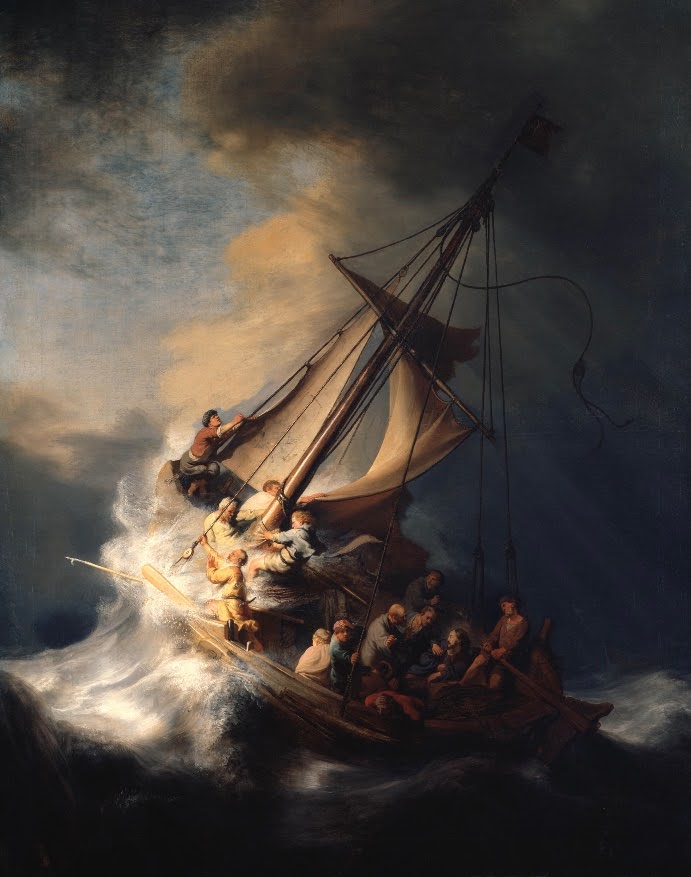
I was getting together my prints for our next Picture Study time with my granddaughters and I pulled out an old book I have called "Rembrandt and the Bible."
I looked over some of my favorites, and then my eyes fell on “Storm on the Sea of Galilee.” It’s not one of the six for this term, but I like it anyway.
And it brought back some memories. I recalled a time I taught a children’s Sunday School class, using Charlotte Mason principles and picture study. (As the church’s Christian Education Director, I had some liberty in curriculum. I used CM’s principles many times in that role over the years.)
I sat in the low chair with the kids at the round table, surrounded by bold murals of Noah’s Ark. (I’ve often wondered if those who use that account for church nursery decor recognize its full story of death and destruction, and of God’s deliverance to an obedient few. But I digress.)
We opened the large book and I showed them the picture. I introduced the idea of narration to them, and I gave them time to look carefully at the painting.
I closed the book, and they told it back to me. “There was this boat,” one of them began. “And a big wave!,” another chimed in. One child went on and on with quite a few details. Not to be undone, one boy said loudly, “I saw a guy throwing up!” (Truly, I had never noticed that before.)
And then we talked about how Jesus was in the boat during the storm. Because this was our church time, we opened the Bible and read the historical accounts from the different Gospels of this moment. One young observer asked why the artist hadn’t included the “other little boats.” And we talked about the miracle that followed.
The kids decided to re-enact the painting in a kind of tableau. It wasn’t done up with great costuming or beautiful sets. It was a jacket or two, a blanket from the nursery, more little chairs were arranged, someone was Jesus, and one kid was “the guy throwing up.”
I’ve often wondered what they told their parents about that Sunday School class that day.
But that painting has come to my mind a lot lately. I’ve thought about the period of time in Rembrandt’s work. It depicted a terrible storm - one that caused seasoned, professional fishermen on a familiar sea to be filled with terror. Wave crashed upon wave, unrelentingly.
And Jesus was in the boat. He was the same One they’d seen perform miracles; recently, even.
The big moment is yet ahead - Jesus will calm the storm, still the waves, and all will be well.
But often we’re stalled out in Rembrandt’s painting. No calm, no miracle, no stillness. Wave upon wave is hitting us, with no let-up in sight. Hardly the stuff of encouragement, of blessed assurances, of all-is-well.
And yet - Jesus was in the boat all along. Jesus is with me in my storms today. He has performed miracles in the past. And He may show His mighty power yet again. And I come to Him with my troubles and fear in my heart, asking for Him to do again what He’s done before, or for what I believe He can do now.
But in the meantime, I’m safe. It surely doesn’t look like it or feel like it. And sometimes I might feel more like the guy losing his lunch over the edge. But Jesus is with me, before, during, after. I’m safe. And He is safe to trust.

At AmblesideOnline, we're praying for you and yours today. Lean on Jesus. He’s with you, no matter what waves are hitting you.

Monday, January 1, 2018

New Year's Meditation (poem by Charlotte Mason)

Charlotte Mason published the following poem, titled Education, in the volume 4 (1893/4) edition of the Parents' Review.
Several years later she republished it in volume XVI (1905), in the opening pages of the New Year, retitled now as "New Year's Meditation."

I thought it fitting to repost it here for our own New Year's Meditation and personal reflection:

Master, Thou will'st me poor--
Haughty and rich am I;
In self-dependence rich,
Presuming, hard, and high:
Faith, looking on the coming years, doth see
Dark faults, sore failures, let to humble me.
Thy will be done!

A mourner must I be:
And holy messengers
Oft have Thy presence left,
To bring me blessed tears:
Too soon they fail, and sin's hot breath sweeps by:
Then wilt Thou take the spot and show it me,
Till, weeping, fain I turn to hide in Thee:
Thy will be done!

Meek wouldst Thou have Thy child:
How little can I bear!
How seldom wait for Thee,
Quiet, within Thy care!
Though through provokings, teach me to endure,
Bid errors make me of myself less sure:
Thy will be done!

A hung'ring, thirsting one
Must Thy disciple be;
And I so full! grown fat
On Thy gifts, leaving Thee!
But Thou wilt teach me want, or take away
All lesser food till Thou my only stay:
Thy will be done!

Merciful as Thou art:
Oh, how hard judgments rise!
Oh, this censorious tongue,
Evil-discerning eyes!
Yet His sweet mercy will my King impart,
If by no other way, e'en through the smart
Of pity withheld in my extremities:
Thy will be done!

Pure, e'en in Thy pure eyes:
Single and free from guile;
Oh, when shall these vain thoughts
Pure rising, meet Thy smile?
E'en this through Thee is mine: though it should be
That, first, through purging fires, Thou go with me:
Thy will be done!

Ruled by the Prince of Peace:
How far from this my state--
Oft striving for my own,
Exacting, harsh, irate.
No peace is found in me; but Thou wilt come
And make this chafing bosom Thy sweet home:
Thy will be done!

Thus I abide His time;
For hath the King not sworn
That all these shall be mine,
And will not He perform?
If tender ways shall serve, such wilt Thou use;
But smite, if need be; I would not refuse:
Thy will be done!

Thursday, August 25, 2016

What Can Happen When You Sing Hymns

by Wendi Capehart

My eldest daughter and her husband have been singing with their kids forever.  Okay, not literally forever, as her kids are not very old- 5, 4, 3, and 1.  However, from the childrens' perspective it is forever, because she was singing hymns to them when they were still in the womb.  I have a vivid memory of her singing to her firstborn while he was being resuscitated after being born gray, limp, and unresponsive. I am positive he stayed with us to hear more of his mother's songs.
   Very recently this busy family has been working specifically on the hymn Trust and Obey. This mainly means they make sure to sing it every day in a more focused, intentional way. I could tell Trust and Obey was their current hymn because while the grandchildren were visiting me recently, they gathered themselves and their baby cousins together on my stairs and sang most of the hymn together, and my grandma heart was warmed to the core. Imagine the joy of hearing your small grandchildren spontaneously singing hymns together just for fun, because they want to.
A couple of days ago, the four year old unfortunately did not obey, and this resulted in an unplanned trip to the emergency room where she had to have a blood draw to determine just how dangerous her disobedience had been.  To be honest, it  was a pretty rough experience for them all, and perhaps especially for our small grand-daughter..
Her brother was born with a medical condition requiring regular blood draws, so she knows more about it than most four year old children.  When she saw the white-coated staff coming toward her, she knew what to expect, and she was upset. Her mama offered to sing to her to help her think about something else, and asked what song she would like Mommy to sing. 
She was still thinking about what song she wanted when the process began. It wasn't their fault- the ER room was swamped, and other patients were waiting.  The staff was as kind as possible, but they were forced to rush.  They began with back to back. simultaneous and brutal sticks- again, not their fault. She is not an easy stick.  It was at the moment this torture began that my grand-daughter  blurted out her answer to her mama's question- she sobbed out "Trust & Obey!" as the hymn she needed her mommy to sing.
Paul and Silas sang hymns in prison, and they were able to do that because they already knew hymns and were used to singing them.  She was able to come up with that hymn when she needed it because she already knew it.  It's a recent part of her family stock of songs. She endured while Mommy sang. But more was yet to come.  They took the finished blood draws and dashed out of the room so they could quickly get it to the lab and move on to other patients.  Not much later a nurse returned, saying, "Bad news. one of them clotted before they could analyze it. I'm afraid we need another draw."

Can you imagine how my little grand-daughter must have felt when she heard this?  What do you suppose she was thinking when  someone else came in and chatted gently with her while looking for another vein to jab in this petite morsel of a four year old?  
Would you believe that she was thinking of another hymn to sing and even choosing the order (she is a bit of a control freak at times)?
 While the nurse was searching for her vein, my nervous and fearful grand-daughter asked her Mama, "Can you sing Jesus Loves me & Trust & Obey? Sing Jesus Loves Me until she puts the needle in and then sing Trust and Obey."   She then started chatting with the nurse about this song her family listens to on the computer and then sing together at home, and how it goes... and she sang a good chunk of Trust and Obey on her own to the nurse.  My daughter tells me the nurse listened for a while and then said, "I just think it's so special that you sing with them like this! 
We are all very encouraged and inspired by this story, although the irony is not lost upon us that she had this opportunity to share this 'testimony' with the nurse precisely because she had not obeyed.  She is not a holier than thou, priggish miss who never does anything she shouldn't.  She is much more like the little girl in the Longfellow poem, the one with the curl in the middle of her forehead ('when she was good, she was very, very good, but when she was bad, she was horrid!')
There are many children, and adults, too, who might find deep comfort and sustenance in singing these old hymns in times of trial (or in expressing joy).  But they cannot, because they have never learned these hymns.  Some Christians don't really even see the point in learning hymns. It smacks of rote religion, I suppose, or perhaps it brings a faint whiff of fusty, musty, dead faith. I do not know why- I grew up in a family where a hymnal was a standard part of our 'things to do in the car' on trips and we sang hymns while doing dishes as naturally and easily as we argued over whose turn it was to do the dishes.  It may be something 'not done' any more, but that doesn't mean it's outdated and old fashioned.  It means we are cut off from our roots.
Is any among you happy?  .... merry? .... sing praises.... (James 5:13)
I will sing with my spirit, but I will also sing with my mind. (1 Corinthians 14:15)
...sing psalms, hymns, and spiritual songs with gratitude in your hearts to God. (Colossians 3:16)
Speak to one another with psalms, hymns, and spiritual songs. Sing and make music in your hearts to the Lord. Ephesians 5:19
About midnight, Paul and Silas were praying and singing hymns to God.  Acts 16:25
 Regular singing, both personal and congregational, of Psalms and hymns and spiritual songs has been part of the Christian tradition from the dawn of Christianity. It is the birthright of every child from a believing family. But we, like Esau, have squandered our heritage for a mess of pottage, very much like Esau, in fact. Esau didn't want to bother to prepare or fetch his own food, and we don't think we need to sing our own songs any longer.  In fact, we think we can't because we don't sound like trained musicians and we don't have dub-step at home, so we might, at best, listen to somebody perform these songs once in a while.  Listening to a performance may lift our spirits, but Christianity is not a spectator sport. It's personal. It's intimate. It's relationship.  
We think the hymns that sustained the believers who went before us are  too hard, too old fashioned, out of date, irrelevant, especially to little children.   My grand-daughter is, of course, quite advanced for her years.  She is bright beyond her chronology.  Nevertheless, she is still only four years old.   She was near panic in a very frightening and painful situation, and yet, even in that traumatized state, she was encouraged, strengthened, and comforted by a hymn over 100 years old. In fact, it is the hymn that came to mind first for her.  This happened because she knew the hymn, because her parents did not decide for her that she could not relate to it or understand it.  
In a CM education we build relationships, develop good habits and nurture affinities to complex ideas and practices such as singing hymns, personally engaging in observation for nature study, poetry, art, and great books.  We do these things when the children are young so that these connections are already there for the children to draw on when they need them.   While God can, of course, work miracles, most often, he works with us where we are. Just the right hymn coming to mind when and where we need it is more likely to happen when those hymns are already a natural, integrated, whole part of our lives. 

Please. Sing with your children.

P.S. Grand-daughter's bloodwork all came back fine, and she left the ER saying to her mum, "I guess next time I should.... obey."

Thank-you to my oldest daughter for many things- permission to share this story and edit your words for an AO publication and for being the mother you are to those precious children, and for choosing the good man you did to father those darlings.  A big thank-you to all the mothers of my grandchildren, because you all sing hymns with your children regularly and you all have married good men, so a story like this could have come from any of you.

Monday, December 7, 2015

Some Christmas Thoughts from Charlotte Mason

Excerpted from Parents and Children, abridged and edited by Karen Glass

It takes the presence of children to help us to realise the idea of the Eternal Child. The Dayspring is with the children, and we think their thoughts and are glad in their joy; and every mother knows out of her own heart's fulness what the Birth at Bethlehem means. Those of us who have not children catch echoes. We hear the wondrous story read in church, the church-bells echo it, and our hearts are meek and mild, glad and gay, loving and tender, as those of little children; but, alas, only for the little while occupied by the passing thought. Too soon the dreariness of daily living settles down upon us again, and we become a little impatient, do we not, of the Christmas demand of joyousness.

But it is not so where there are children. The old, old story has all its first freshness as we tell it to the eager listeners; as we listen to it ourselves with their vivid interest it becomes as real and fresh to us as it is to them. What a mystery it is! Does not every mother who holds a babe in her arms feel with tremulous awe that, that deep saying is true for her also, 'The same is my mother'? [Matt 12:50; Mark 3:35]

In [the little child] is the light and life of Christ; and every birth is a message of salvation, and a reminder that we, too, must humble ourselves and become as little children. This is, perhaps, the real secret of the world's progress––that every babe comes into the world with an evangel, which witnesses of necessity to his parents' hearts. That we, too, are children, the children of God, that He would have us be as children, is the message that the newborn child never fails to bear, however little we heed, or however soon we forget. The note of childhood is, before all things, humility. An old and saintly writer has a luminous thought on this subject of humility.

'There never was nor ever will be, but one humility in the whole world, and that is the humility of Christ, which never any man, since the fall of Adam has the least degree of but from Christ. Humility is one, in the same sense and truth that Christ is one, the Mediator is one, Redemption is one . . . There are not two Lambs of God that take away the sins of the world. But if there was any humility besides that of Christ, there would be something else besides him that could take away the sins of the world.' [William Law.]

Our common notion of humility is inaccurate. We regard it as a relative quality. We humble ourselves to this one and that, bow to the prince and lord it over the peasant. This is why the grace of humility does not commend itself even to ourselves in our most sincere moods, but this misconception confuses our thought on an important subject. For humility is absolute, not relative. It is by no means a taking of our place among our fellows according to a given scale, some being above us by many grades and others as far below. There is no reference to above or below in the humble soul, which is equally humble before an infant, a primrose, a worm, a beggar, a prince.

Humility does not think much or little of itself; it does not think of itself at all. It is a negative rather than a positive quality, being an absence of self-consciousness rather than the presence of any distinctive virtue. The person who is unaware of himself is capable of all lowly service, of all suffering for others, of bright cheerfulness under all the small crosses and worries of everyday life.

The Christian religion is, in its very nature, objective. It offers for our worship, reverence, service, adoration and delight, a Divine Person, the Desire of the world. Simplicity, happiness and expansion come from the outpouring of a human heart upon that which is altogether worthy. But we mistake our own needs, are occupied with our own falls and our own repentances, our manifold states of consciousness. Our religion is subjective first, and after that, so far as we are able, objective. The order should rather be objective first and after that, so far as we have any time or care to think about ourselves, subjective.

Now, the tendency of children is to be altogether objective, not at all subjective, and perhaps that is why they are said to be first in the kingdom of heaven. This philosophic distinction is not one which we can put aside as having no bearing on everyday life. It strikes the keynote for the training of children. In proportion as our training tends to develop the subjective principle, it tends to place our children on a lower level of purpose, character, and usefulness throughout their lives; while so far as we develop the objective principle, with which the children are born, we make them capable of love, service, heroism, worship.

This kind cometh forth only by prayer, but it is well to clear our thoughts and know definitely what we desire for our children, because only so can we work intelligently towards the fulfilment of our desire.

During each coming festival of the Eternal Child, may parents ponder how best to keep their own children in the blessed child-estate, recollecting that the humility which Christ commends in the children is what may be described, philosophically, as the objective principle as opposed to the subjective, and that, in proportion as a child becomes self-regardful in any function of his being, he loses the grace of humility. This is the broad principle; the practical application will need constant watchfulness and constant efforts, especially in holiday seasons, to keep friends and visitors from showing their love for the children in any way that shall tend to develop self-consciousness.

This, of humility, is not only a counsel of perfection, but is, perhaps, the highest counsel of perfection and when we put it to parents, we offer it to those for whom no endeavour is too difficult, no aim too lofty; to those who are doing the most to advance the Kingdom of Christ.

(Read the unedited chapter here.)

Tuesday, October 27, 2015

Speaking as a caterpillar

by Anne White
And the Caterpillar talked all the rest of her life to her relations of the time when she should be a Butterfly. 
But none of them believed her. She nevertheless had learnt the Lark's lesson of faith, and when she was going into her chrysalis grave, she said–"I shall be a Butterfly some day!"
But her relations thought her head was wandering, and they said, "Poor thing!"
And when she was a Butterfly, and was going to die again, she said–
"I have known many wonders–I have faith–I can trust even now for what shall come next!"
(Margaret Gatty,  "A Lesson of Faith" in Parables from Nature
Last weekend I had the chance to speak to a group of CM people about vision...having a vision for education, for families, for the future. It was only later that I made the connection with the subtitle of Minds More Awake: The Vision of Charlotte Mason. But it all comes from the same place. Having just sat through a dramatization of "A Lesson of Faith," it was almost impossible anyway not to be thinking along those lines.

There's one point in the story that I had never considered much: that of the cabbage leaf itself.
"New, news, glorious news, friend Caterpillar!" sang the Lark; "... I will tell you what these little creatures are to eat"–and the Lark nodded his beak towards the eggs. "What do you think it is to be? Guess!"
"Dew, and the honey out of flowers, I am afraid," sighed the Caterpillar.
"No such thing, old lady! Something simpler than that. Something that you can get at quite easily."
"I can get at nothing quite easily but cabbage-leaves," murmured the Caterpillar, in distress.
"Excellent! my good friend," cried the Lark exultingly; "you have found it out. You are to feed them with cabbage-leaves."
One of the other speakers at the retreat described what happened when their church-planting ministry decided to drop fancy Bible study materials and focus on the book itself. Something that they could get at quite easily. She described the power of this approach not only on the mission field, but, shockingly, back in Canada as well. Charlotte Mason mentioned a "smoke and water feast"; Mrs. Gatty spoke of dew and nectar, but it's the same thing: we worry over what we can't provide, when the cabbage leaves are all around us.

Some day I'll be a butterfly. For the time being, I'm a caterpillar. I need to be in relationship with my cabbage-leaf universe, and to nourish others from the stuff that is right under our noses sensory receptors.

It is glorious news.

Tuesday, April 8, 2014

All the things I wanted to say, Part Four (last one!)

by Anne White

How do you keep resources and time organized in the upper years?

Charlotte Mason supplied her students with a carefully thought out timetable.  It made sure there was variety in the day, that a subject heavy in writing was followed by something different, and so on.  This also helped to keep things running smoothly when there were different ages working together,  needing the teacher's attention at different times. But since we want to encourage our students to take some responsibility for their own learning, we may decide to just give our older students a schedule or a list of things to be accomplished in the day or in the week, and let them figure out what to do when. At our house we are using a modified workbox system, where I load a row of magazine holders with the books we need for the day's school; but I also have a "teacher's binder" with lists of the chapters to be read and other ideas for the term. There are all kinds of ways to keep things on track, but which ones work best for you are going to depend on the particular needs and styles of you and your students, as well as whether you have your "courses" divided up into just a few major credits or not.  It's not hard to provide a few drawers or folders marked "Math," "Science," "Literature" and so on; but some parts of a CM education don't fit perfectly into those categories, and you may prefer to keep things a bit looser.

Cindy Rollins, longtime keeper of the Ordo Amoris blog, has a ritual called Morning Time, where all the students (and mom) get together and read things like poetry and Plutarch, do memory work, whatever works well as a group; and then they go off to do their invidual work. When I was homeschooling a middle schooler and a third/fourth grader together, we did a lot of combined readalouds and even things like science study together too; for those two years I tried to pick resources that would work for mixed grades.  Again, you may have to try things out; some students work well together, some work best with a parent, and some want to do it all on their own.

What are the possible pitfalls and problems of using CM in the upper years? What Daleks may try to exterminate your homeschool?

1.  Don't compare, don't worry about what everyone else is doing (or how well they're doing it).

2.  Don't underestimate the children, focusing on limits rather than possibilities.  One pitfall might be to overdo everything, overload and burn out; but the other might be to assume that certain subjects or books are too long, too difficult, or not relevant to today's world. Charlotte said not to drop whole subject areas just because we ourselves think they're too dry or too hard; it is important to open as many doors as we can, do as much exploring as possible.

3.  Even older kids need some variety, some surprises.  Charlotte Mason criticized people whose dinner menus were too predictable; I think she would have said the same about lessons that were always the same. Unless you have one of those students who gets severely stressed by mom's attempts to mix things up (there are some of those too), it's good to include some little twists and surprises.  Do some math or grammar orally.  Play a math game.  Spend some science periods looking through the microscope, or otherwise learning the material in a different way.  Find something different or interesting to do on Tuesday mornings or Friday afternoons--that might be when you check out nature trails, or discount times at the museum, or visit an elderly neighbour.

4.  Don't forget the whole-cookie analogy.  In our family, we tend to take a relaxed approach towards writing, including essay writing; we do use some commercial resources, but it's not very "programmed." Sometimes I've wondered if I'm shortchangiing my students by not making as big a deal of the formal, five-paragraph essay as other homeschoolers do; or by not giving them enough creative writing assignments. However, our older girls who have gone on to public high school have frequently had their papers picked out of the pile as exemplary.  And our youngest won a place in a student poetry anthology this year.  So the whole (cookie) is not made up of trying to glue a whole lot of unconnected crumbs together; the "top down" method of teaching writing largely by example seems to be just as effective.  (We use a few formal resources as they get older; it's not all osmosis; but I still think CM has given us an appreciation of what it is to learn these things naturally.)

To switch from Dr. Who to Star Trek for a minute, I like the ending of "The Undiscovered Country." Captain Kirk is heard in a voiceover saying:
Captain's Log, Stardate 9529.1: This is the final cruise of the Starship Enterprise under my command. This ship and her history will shortly become the care of another crew. To them and their posterity will we commit our future. They will continue the voyages we have begun and journey to all the undiscovered countries, boldly going where no man - where no one - has gone before.  
You are the worldshakers, the innovaters, the ground-breakers, the brave ones. You may have to fight off a few Daleks on your journey through the galaxy, but the adventure will be worth it.

And to add one thought for Christians who are listening or reading:  I heard this week from a pastor (and former homeschool mom) who has organized a series of short-term missions trips to Asia, focusing on children's ministries.  Being a person who likes order and organization, she always plans ahead as much as possible.  On this particular trip, she felt unusually un-organized; her team was much smaller than originally planned, she had fewer ideas written down, and so on.  However, she committed the trip (and her anxiety) to the Lord, and they went ahead, working in co-operation with a local church.  Can you guess what happened?  An unusually large number of children not only came for the programs, but committed their lives to Jesus Christ.  When we are weakest, He is strongest.  (Or to put it as the pastor did--when our binders are the emptiest, He has the most room to fill in the details.)  This is not to discourage planning ahead!--but rather to remind us all of God's faithfulness.  If He has called us to this journey, He can carry it out as well.

Tuesday, November 26, 2013

Some of the Difficulties of Modern Motherhood: A New Parents' Review Article, Part 3 of 4

Part 1 is here
Part 2 is here

Without going so far as the complete separation suggested in this scheme, there is no doubt that the whole tendency of modern life is, for the poor as for the rich, towards an alienation of the children from their parents - Sunday schools, games clubs, free meals, even the "happy evenings for the little ones," what excellent schemes they all are!  Yet I confess that full of admiration as I am for each individually, as a whole, I dread their results.

Nature is a stern economist, and unused powers soon atrophy, and when all the mother work has been taken over by State and Philanthropy, home life will cease to exist, and the best incentive to heroism and self-devotion will disappear, with the last of the old-fashioned mothers.

But the question especially before us in this paper- the question that I am earnestly hoping some other parents will help me to answer, is what ought we mothers of the middle and upper classes to do in this matter? Are we to give up the management of our children altogether to experts in each phase of child life, or are we to "face the music" of professional criticism and insist on doing a certain amount ourselves?  Personally, I do not think there can be any complete or definite answer to this question.  Each mother must decide for herself, what she can and will do for her children, for it is not every woman who can nurse a sick child, or teach a wilful one.  Two things only I venture to plead for. Let us keep some definite share in our children's lives- if we cannot teach them, or nurse them, then at least let us play with them, or work with them, but at any rate, have a real personal share in the young lives, somehow, so that we may not become to our children the mere payers of bills, and adorners of childish garments.

The other definite duty that I should like to urge is that the mother, what ever else she gives up, should at least keep in her own hands the first religious instruction of her children, surely, the God who has knit together with such amazing closeness the lives of child and mother must have intended the first knowledge of Himself to come from her.  No two human beings think of God quite in the same fashion, but by teaching the little ones ourselves we can at least make sure that the first image help up to the childish mind is the noblest and most beautiful we ourselves can conceive. In this case it is really no excuse to say, "I am no good at teaching."  No one need be a professor of theology or a trained instructor to impress upon a child's mind the one great fundamental truth that underlies all true religion- that in all that He says and does and is- God is Love; so that our little ones "being rooted and grounded in love, may be able to comprehend, with all the saints what is the breadth, and length and depths and height- and to know the love of Christ which passeth knowledge."

This one lesson, so simple that the babies can understand it (sometimes they seem to understand it better than their elders) so deep and complicated in connection with the mysteries of sin and suffering and death, that even the wisest of our clever sons can never fully grasp it, this we must face boldly with our children or neglect the greatest opportunity that God has given us; for when a boy learns from his mother's lips, with all her soul's tenderness in voice and eyes, that her love is but a shadow dim and imperfect of the love of God, then he gains an impression of God's love that in beyond all words, and that no one else on earth can ever give to him.

But it may be urged this great lesson does not cover the whole ground of a child's religious education.  That is true, and although I have not the smallest doubt that it would be better for the child to have learnt this lesson, and missed all the rest, than to have learnt all the rest and never mastered this- still there is no reason why the rest should be neglected. Here comes in the difficulty....

To be continued

Background information (from the first part of the article):
Our source for this article: Previously, I shared how the Advisory obtained the Parent's Review volumes which our volunteers have typed for Leslie to put on the website.

Shortly after that blog-post, our volunteers finished typing up the last of the 9 volumes that were in the Advisory's possession.  Providentially, we believe, at that same time one of our AO users shared that another volume was available for sale in England at a charity website.  It was shockingly underpriced (I think about ten pounds), so I scurried over there and bought it.  (I really love the internet, don't you?)  It's volume 19, published in 1908.    You can see the table of contents listed here on our website.

We'll be posting more photographed pages to share for volunteers to type as soon as I can coerce, er, I mean, cajole and convince, my 17 year old to photograph it for us. Her 23 year old sister did the photographing of volume 2 for us and she does physically still live at home, however, she is currently absorbed in college work and wedding plans.  The 17 year old is lobbying for a reduced school schedule in exchange for photography work. (Updated: we had come to an amicable arrangement, and then ran into camera problems, and we are now awaiting a new charger).

In the meantime, I thought I'd share an article that I enjoyed here on the Advisory Blog. I'll be posting it in installments.  I hope you enjoy it as much as I!

Sunday, October 6, 2013

Pastor Chuck Smith, 1927-2013

Many of you may not know who Chuck Smith is. But if you use Ambleside Online, even if you use only the artist or composer rotation, you have directly benefited from his ministry.

Although I am the only "Calvary Chapelite" of the AO Advisory, I have been influenced by the Calvary Chapel movement for my entire Christian life. AO has the same top-down leadership model, with the Advisory making decisions: we seek to be true to our vision, rather than appealing to the changing whims of a user base. I don't often like to pull out the "AO was my idea" card because, although the initial curriculum concept was mine, the creation of the booklist was mostly the work of the more well-read members of the Advisory. My fantastic brilliance is not in putting together a curriculum, but in putting together the right people and convincing them that the project wasn't such a crazy idea, and convincing them that it was something doable. Then I mostly stepped back and relegated myself to webmaster. But I'm pulling out that card now. AO was my idea. And perhaps my biggest contribution, aside from recognizing who needed to be involved, was the insistence from its inception that it needed to be something anybody could use for free. Nobody had to pay us, or me, to utilize AO. AO was (and is) run by volunteers who view the project as a ministry. That is also Pastor Chuck's influence, modeled after his emphasis on blessing others as a ministry, not a profit venture, even though we recognize the obvious marketing potential of AO.

This is a more personal post, about my own history and my own life, which has been largely influenced and inspired by Chuck Smith and Calvary Chapel. I became a Christian in 1983 while in the military in Okinawa. The group of young Christians I fell in with talked in glowing terms about this church called Calvary Chapel back in California that welcomed young people and taught straight out of the Bible. So when I ended up stationed in Oceanside, I naturally looked them up. The first time I walked into a Calvary Chapel (I think it was a mid-week Bible study), there was a guy with an acoustic guitar and a girl sitting on a stool up in front singing and leading worship. It seemed natural, no hype, and very real. It felt like coming home. The teaching was plain, no yelling, no theatrics, just a guy talking,  explaining the Bible in a way I could understand, and that was refreshing.

During the three years between military and marriage, I was a part of the congregation of Calvary Chapel Oceanside (at the time, they were meeting at the local YMCA and the pastor was Bob Dietz and we would hear YMCA announcements from the concession stand over the PA during church service: "Number 4, your pizza is ready!"). Every chance I got, I would go with friends to "Big Calvary" in Costa Mesa, about an hour away. Often that was their Friday night Christian concerts. We were also going to Thursday night Bible studies at Calvary Chapel Dana Point, where Chuck Smith Jr. was teaching, and I went to a women's study at Calvary Chapel Vista taught by Cheryl Broderson, Chuck Smith's daughter. Being young and single and a brand new Christian, I spent a lot of my spare time listening to sermons on cassette - mostly Chuck Smith. And when Calvary Chapel started a radio station - KWVE - I listened to a lot of Calvary Chapel teaching - Greg Laurie, Raul Ries, Jon Courson, Don Johnson. Thus, much of my understanding of what it means to live as a Christian was learned from Calvary Chapel -- either directly from Pastor Chuck, or indirectly from one of his students who had gone on to plant a church somewhere else.

During that time, I met a recently divorced guy at work who was interested in Christianity, so I directed him to the one Christian I knew at work, who was involved in a spin-off Calvary Chapel church called Horizon Christian Fellowship, pastored by Mike Macintosh. The guy ended up becoming a Christian and a year or so later, I married him and we went to his church, Horizon, and Maranatha Chapel, another Calvary Chapel spin-off where Ray Bentley was the pastor. Horizon was meeting in an old school the county was no longer using. When they needed a larger facility for Sunday morning services, they built a gymnasium at the church's expense on the school grounds that they could leave as a gift to the county when the county needed the school back. While the church was using the school grounds, they would allow kids from the neighborhood to use the gym when church services weren't going on. That act of generosity impressed me and modeled the ideal for me of how Christians should act towards their neighbors.

When we started our family a year later, we decided we'd like our children to grow up in a more rural area where they could have a more normal childhood, away from gang violence which was increasing in San Diego. We drove from San Diego to Tennessee with a 4yo and a 2yo. During the very long drive we listened to Praise Band music from Maranatha Music. We were confident we'd have no problem finding a church -- after all, we were going to be living in the Bible Belt. But it wasn't as easy as we had expected. There were plenty of churches, but nothing with the kind of Bible teaching we had grown accustomed to. We even found a church that was sort of a copy of California mega-churches. I think it would be considered a "seeker church" and they had rules they made new members read before joining about what wasn't allowed (no hand-lifting, for example) because "it might make new people uncomfortable." And, although anyone could walk in from the street and feel at home, the Bible teaching was not what we hoped for. We thought our hopes of finally finding a church would be realized, but we were only there for two weeks.

One morning during our search for a church family, I woke up and it hit me -- the natural, reverent, Spirit-seeking, Bible teaching kind of church that I had taken for granted for the past ten years was something I had left back in California and I would never experience that again. It was gone forever. At that point we began praying that a Calvary Chapel would be planted in our area, although the chances of that happening seemed remote. Eventually, though, it did happen after we met another family who had also moved from California and were praying for the same thing. We started our own little home Bible study, and that was the seed of the church we have been involved in for the last 17 years.

Calvary Chapel isn't the perfect church. In fact, I've had my own issues with a few things, mostly when homeschooling has changed me. As I learned about attachment parenting (Dr. Sears used to do a call-in radio show on KVWE, so even that resulted from Calvary Chapel's influence), I wished they were more family-inclusive, instead of segregating church, Bible studies and church activities into age groups. As I homeschooled (after hearing James Dobson talk about it, also on KWVE) and I read more because I was homeschooling, I noticed a slight anti-intellectual bias. It's not an official church-sanctioned attitude, but a church whose focus is on saving souls via street evangelism, and recovery of drug addicts, and group leaders and even pastors come from that background, is likely to have that side effect. So, the church is not perfect, but no church is, and I've found that the positives far outweigh the negatives.

So we've been involved in our local little Calvary Chapel, and made that our church home. But any time I had to miss church because of a sick child, I'd tune in to Calvary Chapel's live service and listen to Pastor Chuck. In fact, the last time I was home with a sick child and tuned in, that was the morning Pastor Chuck made the announcement that he had cancer. Maybe it wasn't just coincidence that I happened to stay home that morning, of all mornings -- maybe I needed to prepare for the inevitable. That was awhile ago, a year or two.

This past Wednesday evening we had a real treat -- Terry Clark, a musician we had known of from Horizon Christian fellowship in San Diego, gave a concert. At OUR little church in Tennessee! It was wonderful, like a taste of home. During the music, I had the inkling that there was a reason for the magical feeling of the worship -- almost like a last victory celebration, or a farewell. And I found out the very next morning that Pastor Chuck had died during the night, just a few hours after that concert.

Are you wondering what the point was in posting my life story? This actually does have an AO aspect. As I've mulled over Pastor Chuck's death and my own years as a Christian that have been entirely under his shadow, I've realized how much of Pastor Chuck's teaching has influenced my own actions, and I've also been struck by a couple of parallels. In the last few months, for the only time in the history of AO, I've seriously considered walking away a couple of times. AO has had its (small) share of critics over the years, as any organization does. Recently we've been alarmed to see our project re-posted, re-named, even sold, so we've had to be more responsible about protecting the work. As a result, I've heard AO come under some pretty severe attack -- mostly variations of AO being accused of being stingy because, even though we allow people to use it for free, we can't allow it to be copied, re-named, re-posted, or sold. During those times that I was tempted to defend AO, I would hear Pastor Chuck's voice in the back of my mind answering a question once asked in an interview about how he responded to those who criticized him or his ministry (and you know that a person in the limelight as much as he was probably had all kinds of things said about him). He said he refused to defend himself, that it was his job to continue doing what God had told him to do, and it was God's job to defend him if that was necessary. (And, as far as me walking away from AO, I've had the verses about "not being weary in doing good" pop up at uncanny times frequently enough over the past few months to convince me that I'm supposed to continue what I'm doing, so me walking away from AO is now off the table. That's no longer an option I'm entertaining.)

The other parallel is about the realities of all organizations. At the time we were praying for a Calvary Chapel to start in our rural area, we were told that the process of starting a Calvary Chapel wasn't as easy as the days I remembered, when anyone could rent a storefront and hang a Calvary Chapel sign on the door. There had been a lot of problems with spin-off churches bearing the Calvary Chapel name but being doctrinally off, so "Big Calvary" had started to require that Calvary Chapels be under the official organization and meet certain doctrinal standards. When I see AO going through some of the same growing pains, it's encouraging to know that even an organization as spirit-filled and well-intentioned as Calvary Chapel has had similar growing pains, though on a much larger scale, and they felt justified in protecting their vision and upholding standards of those who wanted to join them.

Calvary Chapel has lost the one who drove, inspired and directed it, and I'm curious to know what that will mean for them. Similarly, in 1923, Charlotte Mason died, leaving her project without the one who drove, inspired and directed it. Mrs. Steinthal, Mrs. Franklin, and all those others whose names I know from Parents' Review articles carried on the work for her successfully. Yet it wasn't the same. Without her wise but warm presence, listening and guiding with a smile but never any word that "left a sting," it couldn't be the same. Times were changing, the needs of the school system were putting pressure on the PNEU to make changes. Without Charlotte Mason there to hold firmly to the original vision, I'm sure there were things that were done that she would never have wanted, compromises made to meet the demands of modern educational board requirements. AO tries to model what a CM education would look like if CM was alive today, but we can't know for sure what concessions she might have made to accommodate today's society. Would she ban the use of computers for her students? Would she encourage BBC productions of Pride and Prejudice and Wives and Daughters? Even if one of the Steinthals or Franklins or others of her students were here to ask, they aren't her and they'd only be making an educated guess.

I tuned in to the live broadcast of this morning's service at Calvary Chapel of Costa Mesa, and I've been listening as I've been typing. His son told a few anecdotes about him, and said that Pastor Chuck loved nature and knew the names of the birds and trees in his local area. Maybe he and Charlotte Mason will be taking nature walks in heaven. There's a thought!

I'll end with Numbers 6:24-26. Pastor Chuck ended all of his services with this; there's an audio of him singing it on YouTube.

The Lord bless thee, and keep thee;
The Lord make His face to shine upon thee,
And be gracious unto thee
The Lord lift up His countenance upon thee,
And give thee peace.