Showing posts with label classical education. Show all posts

Wednesday, January 4, 2017

Why Choose Charlotte Mason?


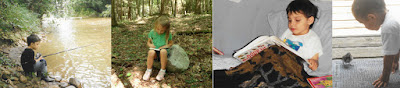
As a homeschool mom, do you find yourself dreaming of meandering in the great outdoors exploring nature with your children and snuggling with them on the couch for a good book, but also torn because you desire your children to have the advantages of the excellence that a classical education has to offer with its high standards and discipline? Are you torn between relaxed days where you can simply enjoy life with your children, and a rigorously structured plan that will enable your children to attain to any career goal they set for themselves?

Why choose one or the other? Did you know you can have both?

A Charlotte Mason education offers structure, ease and enjoyment because of its well-rounded, expansive cohesion. It recognizes that the child is a complete, whole person -- not a trainable, formable being who has the potential to be a person "someday," but a full-fledged person right now -- an individual created in the image of God, with a right to know and experience all that's worthwhile in the wide world. It recognizes that education is supposed to do more than prepare a child for a job: education should expose a child to the diversity and vastness of the universe and give him the tools to appreciate all the variety of beauty and delight that the world has to offer. It should prepare him to live a life graced with zest, and full of connections with all kinds of interests, and a wide range of relationships with people -- not just the people around him, but also those in faraway places, and even distant times. His education should encourage him to find joy in being a useful part of his community. It should teach him to know God. Preparation for a career is important, but it's only one part of a full, rich life.

How can an education fill such a tall order? By carefully arranging an unusually wide variety of subjects in brief time slots at regular intervals that make for shorter school days with less tedious drudgery, and yet still cover a wider range of topics every week than a typical school schedule can offer. A shorter school day allows down time for reflection and dreaming. It allows free time for pursuing interests that have been awakened from the vast array of school subjects.

How does a Charlotte Mason education do this? If you imagine school like a huge church pot-luck laid out fresh every day, the curriculum offers carefully planned and arranged dishes such as lush paintings, constellations and planetary orbits, inspiring symphonies, the seed cycle of flowers, a selection of classic literature rotated for freshness, multiplication and division, Scripture, historical heroes, language arts, principles of the laws of nature, hymns that have built the faith of generations, peeks at what life was like in past ages, the beauty of words arranged in poetry, right triangles, a view of how people live on the other side of the world. All of this delicious fare is served in manageable-sized portions that won't cause indigestion, and without rushing or harassment so that the meal can digest and settle comfortably. The parent/teacher isn't there to force feed anybody, but to serve up portions with a smile, to sit down and even enjoy the meal with the child.

Each child's approach to the table is as individual as his personality. Some children take a heaping pile of art and just a little bit of math. Other children return for second helpings of history, or go back to nibble at science later. The only rule is that every child has to at least try a bite of everything every day. These dishes aren't just facts and data to be choked down like a vitamin-enhanced diet shake. They're ideas that spark curiosity, inspire wonder, and perhaps even lead to life-long passions.

Does the number of subjects sound like the makings of a long school day? It doesn't have to be! A Charlotte Mason school day is typically only two to four hours, depending on the child's age/grade. How can that be? Encouraging focused attention makes these lessons effective, even though they're short. Interesting, narrative books take the place of boring textbooks and maximize time by doing triple duty as they teach, inspire, and offer role models. To make the biggest impact in a student's limited school time, only a few of the best books are preferred over a lot of mediocre ones. Children assimilate not only the best ideas from these books, but the language and vocabulary of excellent writers, too -- and without weekly vocabulary lists!

Does it take a lot of memorization for a child to remember what they learn? No! The key to Charlotte Mason isn't memorization, but narration. A child tells back or writes down what was heard or read in his own words, and the process of mentally going over the material as he clarifies, sequences, and re-creates it in verbal form is what transforms reading into real learning. Narration itself is where the learning takes place! Learning isn't a passive activity, it's something the child does himself by wrestling with fresh material. The parent/teacher's task is to set the meal table at regular times; the child's job is to attend, be engaged, and narrate for the short time school is in session. By recognizing that learning is the child's work, and that it's rewarding work (after all, who doesn't enjoy knowing and understanding things?), pressure is taken off the parent/teacher to make the child learn, and school can become a pleasure. A Charlotte Mason education is enjoyable and life-enriching for both the parent/teacher and the student, yet it provides the kind of knowledge that any classical scholar would envy.

Are you wondering whether you could ever afford this kind of education for your child? Yes, you can! AmblesideOnline offers all of this for free. All you need is access to a computer, some books, and an investment of time to grasp this approach to learning.

-- Leslie Noelani Laurio
_________________________________________


To read more about a Charlotte Mason education, see
http://archipelago7.blogspot.com/2015/03/defining-charlotte-mason.html

To learn more about AmblesideOnline, or to view our booklists, links to free texts, schedules, and additional resources, see http://www.amblesideonline.org/


Thursday, October 1, 2015

Education for All Never Goes Out of Style

Below are the goals and principles of the PNEU as stated in volume 1 of the Parents' Review, published in 1890/91:


Isn't that an inspiring sort of vision statement?  This is really very much where AmblesideOnline is coming from- all classes, religious basis of work, education for all, to help parents, to include all parts of the person- physical, mental, moral, and spiritual.  Our email list and now our forum and our facebook page are there to stimulate enthusiasm, to give parents opportunities for cooperation and to make known the best information and experiences on the subject.

Pay no mind to the Victorian style imagery- I use that primarily because it's in the public domain and easy for me to find (and I do think it's cute).

But make no mistake- this kind of education never goes out of style.

It's not old-fashioned just because it relies heavily on the great books that have been part of the great conversation since books were written.  In volume six, Mason is giving a sort of general overview of the literature she uses.  She explains that the reading for high school "is more comprehensive and more difficult. Like that in the earlier Forms, it follows the lines of the history they are reading, touching current literature in the occasional use of modern books; but young people who have been brought up on this sort of work may, we find, be trusted to keep themselves au fait (editor's note: that is, current) with the best that is being produced in their own days. 

It is a modern education and a classical and old fashioned education in the very best sense of each of those terms.  There's nothing out of date about it.

Monday, June 16, 2014

Ages and Stages

by Karen Glass

Charlotte Mason's methods are not (thank goodness!) associated with stages.  However, she did in fact talk about two stages of education.  It isn't the focus of her principles, but her methods are worked out to serve the needs of the stage that was most relevant to her pupils.

Charlotte Mason tells us that "education is the science of relations."
The idea that vivifies teaching in the Parents' Union is that Education is the Science of Relations; by which phrase we mean that children come into the world with a natural 'appetency,' to use Coleridge's word, for, and affinity with, all the material of knowledge; for interest in the heroic past and in the age of myths; for a desire to know about everything that moves and lives, about strange places and strange peoples; for a wish to handle material and to make; a desire to run and ride and row and do whatever the law of gravitation permits. Therefore we do not feel it is lawful in the early days of a child's life to select certain subjects for his education to the exclusion of others; to say he shall not learn Latin, for example, or shall not learn Science; but we endeavour that he shall have relations of pleasure and intimacy established with as many as possible of the interests proper to him; not learning a slight or incomplete smattering about this or that subject, but plunging into vital knowledge, with a great field before him which in all his life he will not be able to explore.
What does that have to do with stages?  Well, we see that Charlotte speaks of "the early days of a child's life."  The first stage, obviously, begins at the beginning, and the work of this stage is to develop relations with every area of knowledge.

Charlotte Mason mentions her stages in volume 5 of her educational series, Formation of Character,  which is not often read because it is less practical, and it is probably for this reason that we have been spared a rigid system forming around these stages. 
There is also a time for sowing the seed of this knowledge, an intellectual as well as a natural springtime; and it would be interesting to examine the question, how far it is possible to prosecute any branch of knowledge, the sowing and germination of which has not taken place in early youth. It follows that the first three lustres belong to what we may call the synthetic stage of education, during which his reading should be wide and varied enough to allow the young scholar to get into living touch with earth-knowledge, history, literature, and much besides. These things are necessary for his intellectual life, and are especially necessary to give him material for the second stage of his education, the analytic, which, indeed, continues with us to the end.
The "first three lustres" is fifteen years, so all the years prior to our high school, and even the first year or two of high school, may be considered part of this "synthetic" stage.  This is a time for gathering first-hand knowledge, developing relationships with every area of learning, and establishing that affection for knowledge that is the foundation for what Charlotte Mason tells us is the vital question about education--not "how much does the youth know?" but "how much does he care?"

After he has learned to care, his maturer mind is ready to analyze what he knows.  For most educators in the 21st century, analysis is the first object, and we expect children to analyze what they learn as soon as they trot off to kindergarten.  Charlotte Mason understood that analysis was the work of a mind "throughly furnished" with much knowledge, and the first stage of education--a long one, allowing plenty of time for relationships to develop--was a time to synthesize knowledge.  Most of us know what analysis looks like, and how to approach knowledge analytically, because this is how we are taught in institutional schools.  The idea of synthesizing knowledge might be confusing, but Charlotte Mason has distilled the idea in her principle that "education is the science of relations."  If we pursue the idea of developing a relationship with every area of knowledge, we are well on the way to making the most of that first stage of education--the synthetic stage--which lays the foundation for the later work of a mature mind.

Monday, April 21, 2014

Narration Through the Ages

by Karen Glass

One of the hallmarks of a Charlotte Mason education is narration. Everyone who inquires into the method bumps into narration almost from the very first, because it is so central. Read and narrate, read and narrate. Because narration is not a widely-used technique today in any other method of education, it is easy to imagine that it is an invention of Charlotte Mason, something particularly her own, but in fact, the practice of narrating goes back for centuries. The preliminary exercises of classical rhetoric, the progymnasmata, include narration as one of the first things young learners would do, beginning with fables or relating simple historical events, and these early rhetorical lessons were sometimes begun even with children. But even narration in the form that Charlotte Mason recommends it--retelling immediately what has been read or heard--is not an invention of her own, but was recommended centuries before by some of the Renaissance educators (and I believe Charlotte gleaned a great deal from them). Consider this advice from Erasmus:
The master must not omit to set as an exercise the reproduction of what he has given to the class. It involves time and trouble to the teacher, I know well but it is essential. A literal reproduction of the matter taught is, of course, not required - but the substance of it presented in the pupil's own way.
Perhaps, reading that advice, or something like it, Charlotte Mason decided to give it a try and found it very effective! Other teachers from the same era, perhaps influenced by what they knew of rhetoric, recommend the same practice. Comenius outlines similar guidelines in his Great Didactic:
Every pupil should acquire the habit of acting as a teacher. This will happen if, after the teacher has fully demonstrated and expounded something, the pupil himself is immediately required to give a satisfactory demonstration and exposition of the same thing in the same manner. Furthermore, pupils should be instructed to relate what they learn in school to their parents or servants at home or to anyone else capable of understanding such matters. This practice will serve various useful purposes: In the first place, pupils will be more attentive to every part of the teacher's exposition if they know that presently they will have to repeat the same matter and if each one fears that perhaps he will be the first to be asked to do so. Second, by restating exactly what has been taught, everyone will imprint it more deeply in his understanding and memory.
So what does it mean? Did Charlotte happen to stumble by chance over an ancient practice or did she discover it in the course of her wide reading on the topic of education? She doesn't tell us, but those of us who make narration an integral part of our educational efforts are not just following the advice of an obscure 19th-century British schoolteacher. We are sharing in a traditional practice of the past, and giving our students a share in the education of Quintilian, Erasmus, and Comenius...as well as Charlotte Mason!