Showing posts with label planning. Show all posts

Tuesday, August 7, 2018

Planning AmblesideOnline from Table to Table


By guest blogger Dawn Garrett


I've had a lot of people ask how I plan an AmblesideOnline term and how I'm helping my children to learn how to manage their work. Since the two go hand in hand, you get one long post :)


For the quick version, you can go to my profile on Instagram and click on the Highlight circle named "Assigning AO" (I think this is an in-app feature only)


We're doing Year 7 right now, so the first thing I do is go to that page and print the booklists (with the footnotes) and read through everything. I use this to determine what books we own and what we need and order all the books. That can be fun. I try to do this a little ahead of when I'm going to be planning - so a week or two before I'm planning to plan. Then I have these beautiful stacks of books.  For Year 7, I knew I'd be doing some adjustments for R-girl, so I printed both the Detailed and Basic/Lite version.


Once I have the books, I download the modifiable ODT schedule and open it in Open Office and copy/paste the table into your favorite spreadsheet application. It should look something like this:


This year, I pulled out some things that were going to be done with Jason and some things that were going to be done during our Morning Time, Whatchamacallit, and left the rest in the main block. You can see where there are blank rows as separators.

Once I've determined how we're going to approach the work, I create a separate spreadsheet for each week (you can see them across the bottom of the page) and put the week number and the dates for that week number).  Then I copy the subject column to each of those tabs and the assignments for that particular week to the tab. So the column headed Week 2 went on the tab named "2 April 23-27." I made a separate spreadsheet for all twelve weeks (plus break weeks).


Each week's tab looks something like the above. I then split out the reading that is assigned to, at maximum, 5 readings per week. Because I have them, I use the books as I'm doing this and some of them I'll put a small (in pencil) star where I want them to stop for the day.  I put the total number of pages assigned in a column and I have a column at the end for the count of readings for each book. That count is summed. In this case, there are 25 independent readings for the week. I don't count those that will be done in Morning Time or with Daddy.


I can then print that week's tab for them - I do hide the column that has the whole weekly reading assignment, and just give them the split up readings.

25 readings is easy to deal with - they can do 5 per day. They don't have to do any on Wednesday (except we generally do Ivanhoe and Beowulf as audiobooks on Wednesday), but they generally choose to in order to cut down the assignments on the other days.  On Monday, they write the assignments in the daily boxes at the bottom of the sheet. This helps them learn to evaluate a week's worth of work and divide it reasonably. We've worked hard to see how doing a little bit every day is better than cramming too much into any given day. We've looked at how that page number column comes into play.

Some day, I hope to hand them the week's assignments and they'll split out the readings, but that day is not yet.


This is the newest step and one we've done for a little more than a term, so it may not stay the same. So far it has worked beautifully. Because we have one set of books for three students, a standard timetable schedule is a nightmare. Also a nightmare: lessons that take all day because there's no sense of urgency or accountability. This system was borne of sheer desperation.

We do Whatchamacallit from 8:30-10:15. After a 15 minute break, the independent work portion of our day begins.

I have a duplexing printer, so I print the above form on the back of their weekly assignment page.  Each day, the children take the book list they have made for the day, Math, Latin, a written narration, and penmanship and assign the work to half-hours. Some things take a full half hour, some don't. They have to be careful with the different books and assign them in appropriate blocks. They have to plan if they're going to read with someone else, or that they don't plan the same books at the same time. It takes some juggling and thought. I love it. So far, it has worked well, with just a few growing pains. It fits with my general philosophy of helping them learn to manage their own workload so they can be independent.

Now, I can start the pre-reading. It's plenty of work, but it's good work.

So, there you go - from AO and their weekly table to the individual day's table how we're planning AmblesideOnline at this time.

It's sure to change.


Dawn Garrett blogs at ladydusk.blogspot.com and is a 
collaborator of the CharlotteMasonIRL account on Instagram. 
She homeschools her three children in Central Ohio.

Saturday, September 30, 2017

Enough

by Donna-Jean Breckenridge

Picture this:

The table is full.  There’s a computer, there are notebooks and art prints - and stacks and stacks and stacks of books.  

It’s a typical summer scene, one that has been here in my kitchen for years.  Dinner, if I can manage it during these weeks of planning, is spread on a picnic table out back, or on trays on the porch.  When I’m really in the thick of it, I have been known to mutter from behind a wall of history, biography, and free reads, “Fend for yourselves.”  There is organizing, combining, synchronizing, and tweaking the calendar (Do I use the half week of Thanksgiving as a catch-up week?  Do I spread that week over two weeks?  How long do I stop for Christmas? Do I try for summer lessons, or just use that time for anything we miss?).

And when I’m finally done with getting ready for the school year, I find that the beauty that is a Charlotte Mason/AmblesideOnline education looks abundant and very, very full.  

Then a funny thing happens. 

When the books find their way to the designated shelves, when the notebooks and supplies land in desks or in bins, when the calendar is in the laptop or phone or absorbed into a daybook, when the homeschool lessons actually begin - 

Suddenly, everything changes.  What was seen as so much, even a little daunting, morphs into inadequate. There is a temptation, even with a rich feast of a curriculum like AmblesideOnline, to use it as a base from which to do more.  

Just read a poem a day?  Yes, that’s nice - but how about several poems read each day for comparison? What about researching the poem, looking for its literary devices, and defining vocabulary words?  Surely several highlighters are needed, at least, maybe in a few different colors?

Literature?  Great books are good, yes, but what about study guides, or supplemental readings, or, again, those lists of vocabulary words?  

History?  Is this the actual best prescribed rotation for the story of mankind, and shouldn’t some of the tales from long ago and the uglier viewpoints of the past be left out?  And why on earth start with the history of a country other than our own?

Nature study?  OK, but my little yard isn’t all that exciting, and a walk in this neighborhood doesn’t yield much to see - so isn’t it best to add videos of nature, of important and real nature, and focus on stuff happening in rainforests and places far away?

Narration? Just ‘tell it back’? Really? That’s it?  Isn’t there more? Shouldn’t it all be written down, corrected, recopied, and used for a study of the principles of composition?  

Hymns and folk songs - just sing them? Don’t we need musical analysis, the history of each work, and lots of hymn recitation?

And just like that, a path of freedom and beauty turns into drudgery, and becomes instead a path towards burnout and exhaustion. 

This feeling that more is needed is just that  - a feeling.  It bears no resemblance to the truth.  I know this now because, well, I’ve been at this for awhile. I’ve homeschooled this CM/AO way since 1990, and the children whose curriculum plans were on my kitchen table this past summer include two of my three grandchildren - the ten- and seven-year-old daughters of the little girl I began to homeschool all those many years ago.  

I’ve learned a lot of things through homeschooling my four children (three of them graduated, one still in high school) and now through helping to homeschool my grandchildren.  And the main thing I’ve learned is this:

It is enough. 

It is enough to park in the poetic mind of one man or woman for a season, and hear their words read aloud, singly, daily, for the inspiration or challenge they bring.  Before long, a student recognizes the poet’s style, and a phrase or stanza or even the entire poem stay with that student, often for a lifetime. 

It is enough to walk around the same yard, the same street, the same park or field, on a simple walk - and find that your child gets familiar with a single tree, with the sound of a returning bird, with the flow of a stream or brook, with the change of the seasons, with decay and renewal, and with wonder over God’s creation.  And the intense observation that comes from sketching a leaf, a feather, a nut, a web, or an animal track is the foundation and the essence of real science.  

It is enough to read a book - not someone else’s take on it.  Imagine if you were given the choice of whether to stand in the front of the crowd and hear Abraham Lincoln give his second inaugural address, or to read a political commentator’s evaluation of it in a newspaper?  It’s the same with literature. There is simply no substitute for interaction with an author, for getting to know and witness firsthand the strength of the words and the force of the worldview.  

It is enough to narrate - to use this powerful tool, even through the first steps of objections, last-word parroting, and missing facts. Very soon a pattern emerges out of the new habit, due to a strengthening of mind muscle, of attention, and of building associations.  Blank stares are replaced with “this reminds me!” discoveries, and connections with other books, history, life.  And the analyzing, categorizing, connecting - and yes, the composing - is done by the child, not the study guide. 

And it is enough to sing, just sing a hymn, and to learn to sing it even - maybe especially - without accompaniment.  There may be no instruments available for your child when he walks in a hard place or wakes from a nightmare or waits for difficult news, and finds comfort and guidance in singing quietly (or bravely),  “When peace like a river attendeth my way, when sorrows like sea billows roll, whatever my lot, Thou hast taught me to say, ‘It is well, it is well, with my soul.’ “

There are some supports used at times in an AO education, of course, such as a study guide for Plutarch, an introduction to a new book, or a more specific essay style-question for a narration. But the general Charlotte Mason principle that “the mind feeds on ideas, and therefore children should have a generous curriculum” does not require for its implementation a paid advisor, an insider’s interpretation of the six volumes, or a heretofore unrevealed new approach to one subject or another.  This method is well-tested, and many of us have lived the harvest of its beauty and simplicity. 

So to the young mom whose table or laptop or library card or Amazon account has been full, and who is daring to go forward but feeling a little bereft and uncertain without charts, unit studies, and workbooks - 

Be reassured. It is enough. 

To the harried homeschool teacher who’s been at this for awhile but life has gotten very tense and now high school looms large, with worry about tests and college and jobs and the future - 

We’ve been there.  It is enough. 

And to the new homeschool mom whose children know facts but don’t care, and who is seeking for them to know Robert Louis Stevenson and Johann Sebastian Bach and William Shakespeare and, above all, the Bible, at least as well as or better than they know the current athletes, musicians, and celebrities - 

Join us, and countless others.  We’ve discovered - it is enough. 

In fact, we’ve learned it’s not just enough. 


It is more than enough.  

Friday, June 9, 2017

Sample Year One Schedule (Guest Post)

The usual caveats apply: this is one sample of one mom's work with one of her kids, and we are excited to be able to share it with you all. We hope it will give you ideas about your own schedules and be an encouragement. It's not a blanket endorsement, a recipe, or a straitjacket. It is meant to be a helpful example. Huge, huge thanks to Tanya for catching the AO spirit and letting us share it.

Tanya moderates a FB support group for San Diego Charlotte Mason Homeschoolers. I'll let her introduce herself:

I'm Tanya Stone. I've been homeschooling for 7 years, since my oldest entered Kindergarten. I've been using Ambleside Online for about 5 years. My children are 12, 11, 9, 7, and 5.


Do you have a schedule to share? Let us know!

Wednesday, May 24, 2017

Guest Post: Year 3 Review

We are excited about this!! You are about to be blessed, especially if you are looking at year 3.

 We want to introduce the Nelson family today, who would like to share with you the details of how they implement AO Year 3 in their homeschool. The Nelson family has three children -- all boys -- and they've been homeschooling with AO for three years, using Years 1, 2, and 3. Diana Nelson blogs at http://takingjoyblog.wordpress.com/ You'll want to bookmark that and follow her blog.

 We are so thrilled to be able to share this post with you.  It is the first in a new series we hope will grow- guest posts by AO users on how AO works for them.   We are so thankful that Diana graciously shared this post with us to use on the blog, and thus with all of you.

We hope her generosity and spirit of sharing freely encourages and inspires others the same way she has blessed us.  So without anymore fanfare- here's Diana on year 3:


As my oldest is about to enter Year 4 (we'll probably start the first Monday in August), I find myself looking for advice from Year 4 veterans. And, since we are just finishing up Year 3, I thought I'd offer that type of advice to those about to begin Year 3. First, and this is in no way scientific, here is a list of Year 3 Books in order of hardest to easiest (those in bold above the line are books I might allow my son to read independently occasionally; those in bold below the line are books he actually did read independently by the end of the year):
  • The Heroes by Charles Kingsley (Literature)
  • Marco Polo’s Adventures in China by Milton Rugoff (Geography)
  • Parables of Nature (AO’s paraphrased edition) by Margaret Gatty (Literature)
  • This Country of Ours by H.E. Marshall (History)
  • Trial and Triumph by Richard Hannula (History Tales / Biography)
  • Bible: New King James Version (Bible)
  • An / Our Island Story by H.E. Marshall (History)
  • *Shakespeare for Everyone: Henry V, A Midsummer Night’s Dream, Taming of the Shrew, As You Like It (Literature)
  • Children of the New Forest by F. Marryat (Literature)
  • The Jungle Book by Rudyard Kipling (Literature)
  • The Princess and the Goblin by George MacDonald (Literature)
  • Pagoo by Holling C. Holling (Natural History/Science)
  • Secrets of the Woods by William J. Long (Natural History/Science)
  • Leonardo Da Vinci by Emily Hahn (History Tales / Biography)
____________________________________________________
  • American Tall Tales by Adrien Stoutenberg (Literature)
  • Child's History of the World by Virgil Hillyer (History)
  • Landing of the Pilgrims by James Daugherty (History Tales / Biography)
  • **[all Year 3 poetry] William Blake, Sara Teasdale, Hilda Conkling, Henry Wadsworth Longfellow
  • Bard of Avon by Peter Vennema and Diane Stanley (History Tales / Biography)
  • Good Queen Bess by Diane Stanley (History Tales / Biography)
  • Science Lab in a Supermarket by Robert Friedhoffer (Natural History/Science)
  • A Drop of Water by Walter Wick (Natural History/Science)

*Our family does Shakespeare together in morning time. We have substituted Shakespeare for Everyone in place of Charles and Mary Lamb’s Tales from Shakespeare – a personal preference.

 **We do poetry in morning time or at "tea time," which is why he did not read independently.

  Specific Scheduled Book Advice Even though A9 can read several of the history / biography books on his own, I was hesitant to just hand it all over to him because we are still doing a mommy-and-me style timeline. A9 is probably an above average reader (he was an early reader), but he's still a reluctant one. He's the type to skim rather than read carefully, so we chose to read aloud more than was probably necessary.

 
An Island Story is an old friend. We've read it for the past three years, so that one is familiar and easy.

This Country of Ours starts out overlapping the timeline in An Island Story, so even though the chapters are longer, An Island Story has brought us up to this point.
Child's History of the World is another book that overlaps. It's by far the easiest reading level of the three main history books scheduled in Year 3.

 The historical biographies are all fairly easy reads. We did Leonardo Da Vinci as a read aloud just because in Term 1 our son was not quite mature enough to read independently AND give a good narration. (Plus, it's a little boring.) A lot of maturing happened this year! By the end of the year I was able to transition more and more over to A9.

 We started American Tall Tales as a read aloud, but he was able to read the second half independently with good oral narrations.

 The most challenging book in Year 3 is The Heroes by Charles Kingsley. Not only is it an elevated prose, but also my son was only slightly familiar with Greek gods and goddesses. A9 picked up Percy Jackson: The Lightening Thief at the library around the middle of Term 2 -- purely coincidentally -- and I think that helped him relate to The Heroes a little better.

 
Marco Polo's Adventures in China was the next most challenging. I know there are many options from which to choose for your Marco Polo book. We landed on Milton Rugoff's after I checked out a few options from our library (inter-library loan). I liked all of the photos, maps, and sidebar info in Rugoff's book. I have seen AO Advisory members comment about the many Marco Polo options, saying that all of them are great books, and the only reason there are so many options is so that there isn't a mad rush on just one version. All that to say, if you're planning Year 3, you'll be tempted to worry and fret over which Marco Polo book to choose. Relax and buy the most affordable and most available one on the AO list of options. And, remember the purpose of this text is to teach geography, so be sure to map out the Polos' travels. We also checked out a book from the library about what Mongolia is like today. I thought it a good idea that A9 understand that parts of Mongolia today are urban and industrial.

  Parables of Nature is another old friend. I would almost be tempted to let A9 read one of these stories independently, but frankly we just enjoy these together way too much. They are a time investment, but when we settle in to these stories we always have deep conversations.

 Even though Trial and Triumph is familiar from Years 1 and 2, I still read this one aloud just in case it raises any questions. There's a lot of death -- and church history (obviously) -- that I want to help A9 interpret. I've seen Catholic AO users say this book is very protestant, and I've seen protestant AO users say this book is very Catholic. I think the book does a fairly good job walking that line (we are protestant), and I can see why the AO Advisory has chosen it. Still, I find this book needs a chaperone.

 My kiddo is so familiar with the New King James Version of the Bible that I find that he gives excellent narrations. In fact, A9 asked to begin a written narration on New Testament reading assignments. Sometimes we also read the same selection out of The Message or the English Standard Version if the selection is particularly challenging (more typically in the Old Testament).

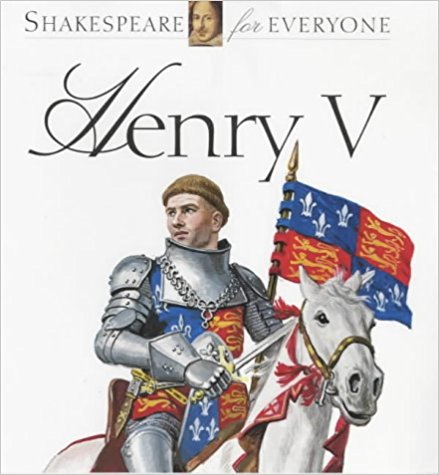
HenryV As already noted, we traded Lamb's Shakespeare for a line of books called Shakespeare for Everyone. I found the Georgian / Victorian language used in Lamb's only confused Shakespeare's Elizabethan era plays, so we opted for a modern retelling followed by film viewings. Because we do Shakespeare as a family, we had our own rotation going rather than juggling Year 1 and Year 3 assignments. Now I see that AO has moved to a Shakespeare rotation, we will probably try to jump on board (so long as we don't repeat what we've done recently).

 I turned over three of the literature selections (by MacDonald, Marryat, and Kipling) for Dear Husband to read to A9 in the evenings. They were all tackled at bedtime with very little involvement from me.

They read Little Pilgrim's Progress by Helen Taylor last year in Year 2. DH says he thinks A9 could have read these independently, but we thought it best to have Daddy pronouncing the words properly and doing character voices.

  Pagoo and Secrets of the Woods for Natural History / Science were reserved as read alouds so we could reinforce the science involved. Rather than giving these over to A9, we checked out additional picture books from the library that involved sea life and woodland creatures to support the scheduled books.

 The other two Natural History / Science books (by Science Lab in a Supermarket and A Drop of Water) were both books I felt I could hand to A9 and he would run with it. We did the experiments together, but really he required hardly any guidance at all.

  Free Reads A9 would not read any of the free reads unless made to do so. He would be much more likely to choose a book from the library based on his own interests (and he frequently does), so we compromised. A9 has assigned free read time during which I set a timer for 20 minutes, and he reads a Year 3 free read of his choosing. So far, in Year 3 he has read:
  • Alice's Adventures in Wonderland
  • Through the Looking Glass
  • Swallows and Amazons
  • King of the Wind
He has also read "on his own time" countless books in the fantasy genre, to which he seems naturally drawn. We've also completed several family read alouds this school year, including The Hobbit, The Borrowers, The Lion, The Witch, and the Wardrobe, Love That Dog, and the Ramona series (Beverly Cleary).

Various Daily Instruction

 A9 is still loving Math U See for his main math curriculum. He finished the Delta book around Easter and has jumped right into Epsilon. I'm also trying to get him interested in Beast Academy math, which is more problem solving style questions. Math nerdiness run in our family, so A9 is a bit ahead in math. I know many kids his age in the Beta or Gamma Math U See books. I love that those books are not grade-specific so kiddos can be comfortable doing their best without undo pressure.

 In Term 3 of Year 3, A9 began learning typing / keyboarding online at www.typing.com, which is a free program that saves his progress. We are still plugging away at Copy Work, but this child is perpetually behind in that department. Even though his handwriting is atrocious, his spelling and grammar are naturally exceptional (I mean that in a good way). I expect dictation in Year 4 to be a breeze.


For foreign language, we went with Classical Academic Press's curriculum. A9 started out with Song School Spanish and has since moved on to Spanish for Children Book A. Next year we will add Visual Latin 1 and see how we do. I'd love for him to add in French someday, but recently he has shown interest in learning Japanese. We shall see what will be.

  Weekly Instruction Subjects We very closely follow AO's artist, composer, and folksong/hymn study rotations, utilizing morning time to do this as a family. Additionally, I have taken A9 and L6 to a couple local symphony performances for a little in-person music appreciation. A9 and L6 both take piano lessons from me at home, and A9 took a guitar class and belongs to a community boys choir, which performs many folk songs and spirituals.


 We also learn about nature topics in morning time, according to my own reading of the Handbook of Nature Study by by Anna Botsford Comstock, various picture books, and field guides. A9 and L6 both sketch in nature journals, and we belong to a weekly hiking group for kids (taking its cue from the Wild and Free movement). Oh, and all three boys are involved in Cub Scouts. We also attend a local school co op one day a week, which gives the boys 4 hours of classroom experience each week. In order to fit this in, we stretch the 12 week AO terms into 15 week intervals.

  Sports and Recreation
 The boys all take a swim class designed for homeschoolers at a local indoor pool. During the winter, A9 played Upward Basketball and participated in an archery for kids program. All three boys are now playing Little League Baseball, and I think A9 and L6 might be interested in track next spring (2018). Probably our best source of recreation, though, is living in a cul de sac where the boys ride their bikes and scooters up and down the street.
  Whew! Man, that sounds like a lot, but remember we're not doing all of it every day. Also, A9 is an extreme extrovert. L6 is much more introverted, so I'm hoping he's going to take it easy on me. J4 seems to be somewhere in the middle. I hope this record of how our Year 3 played out helps someone out there.

 Until next week (or so).

 I'm reading:
Moderately challenging books:
Stiff books:
Diana Save Save

Friday, October 16, 2015

Charlotte Mason is powerful (Part II)

by Anne White

Part I was a long post, but I wanted to show you in detail how even examination questions were not random or afterthoughts in the PNEU schools. Whether or not we ourselves give actual examinations every term, the original questions give us clues about the Charlotte Mason "big picture." What important ideas were the students to appropriate from their schooling? What "power tools" did they now have in their belts?

Along with the exam questions, we can also learn from the Notes of Lessons that appear in Parents' Review articles and in Mason's books. The printed lesson plans begin with a note that such lessons are meant to introduce a new topic, to expand on or bring together something that has been studied in daily work. But for our purposes here, that doesn't matter; the aims of daily lessons would be the same.

I've pulled the goals from about thirty lessons, on subjects varying from needlework to Brazil to algebra. What I've found is that, in many cases, the goals were similar, almost interchangeable between the subjects; they might have been designing a book cover or talking about Latin roots, but the philosophy behind what they were doing reached across the curriculum.  One of the most unique was a lesson on design, where some general principles were demonstrated and the students were to draw a design on paper, but where the actual project (a linen book cover decorated with embroidered flowers) was optional. Here are the goals: 
To give the children an idea of how to fill a space decoratively, basing the design on a given plant.
To show them that good ornament is taken from nature, but a mere copy of nature to decorate an object is not necessarily ornamental.
To give them an appreciation for good ornament and help them to see what is bad.
To draw out their originality by letting them make designs for themselves.
If possible, to give them a taste for designing by giving them some ideas as to its use.
There are several interesting points we could look at there. One is that, in this case, it was not "anything goes"; there was "good" and there was "bad." Also, that just sticking a flower on the table and copying it mechanically isn't art (already we have some big ideas being raised here!). What sort of "originality" is needed in addition? What does it mean, though, that "good ornament is taken from  nature?" How might that relate to larger issues of home decoration or personal adornment? If particular artists (or decorators, or dress designers) chose to flout that tradition, what effects might that have?
 "With intricate welding, Tom delicately veined his leaves, and next stemmed them onto the vines. He felt it good that no two looked exactly the same, as he had observed in nature. Finally, in his seventh intensive week, Tom spot-welded his leafy vines onto their waiting window-grill frames.
"'Tom, I 'clare it look like dey jes' growin' somewheres!' Matilda exclaimed, staring in awe at her son's craftsmanship." ~~ Alex Haley, Roots

More in Part III.

Tuesday, October 13, 2015

Charlotte Mason is powerful (Part I)

by Anne White

Karen Glass, along with other CM and classical educators, has pointed out that our aim in studying the classical tradition is asking "why" rather than "how." What was the ultimate goal of a Charlotte Mason education?

We might list things like "not filling a bucket but lighting a fire"; educating the conscience to make well-reasoned choices (but not to depend wholly on reason); exercising magnanimity and other values such as honour and justice; understanding "I am, I can, I ought, I will"; using the "mind's eye" to recall what has been observed. If education is a science of relations, then to be educated means having proper relationships with the universe, the earth, people, and God. Education allows a generous space and time for minds to meet (also known as the "large room," or leisure). 

Andrew Kern of the Circe Institute wrote, "There is no education without leisure for the simple reason that education is a leisure activity. It requires all of the other values: controls, freedom, money, and honor. But its only true end is virtue for the simple reason that only virtue is big enough to rightly order the other goods. The wise man...is not driven by [his desires] as by an unruly mob. Instead he governs them." ("Leisure, Plato’s Republic, and American Education"). Lynn Bruce defined leisure as “ceasing from anxiety and merely utilitarian preoccupations so that one can contemplate higher things, those pursuits without which we cannot be fully human.”

One of the worst things C.S. Lewis had to say about the character Eustace Clarence Scrubb is that he "hadn't read the right books." It implied that Eustace, although stuffed full of utilitarian facts, was completely lacking in imagination and understanding. When Eustace was drawn into a Narnian adventure, he could only squawk about personal discomforts; when he was kidnapped by slave traders, they misheard his name as "Useless" and couldn't wait to be rid of him.

So we have our "why." We are looking for something "big enough" (Kern), "higher" (Bruce), wide, large, generous, and "beyond ourselves." To put it very shortly, we want children to be educated for virtue. And we don't want them to grow up useless.

We have our "what": "we train him upon physical exercises, nature lore, handicrafts, science and art, and upon many living books."

How did Charlotte Mason's lessons integrate those two to make a "how?" The desire to teach with Mason's principles is admirable, but its application can be frustratingly vague. Some people using Mason's methods see quick and almost magical success, even (or particularly) with "difficult" students. Others of us have continued, years along, to wonder if we're doing it right, or if we're missing some crucial point, particularly after taking a student through a round of examinations and getting one-sentence responses, or, worse, "I don't remember that at all." 

The early teachers coming from the House of Education, and even the parents following PNEU programmes, expected better results (I use that word carefully), and, if we can judge by the printed examples, they got them. Although Charlotte Mason insisted that there was no education but self-education, and that each student had to perform his or her own act of learning, she also emphasized the need for working with, not against, human nature and the makeup of the mind. She believed that most children could "love to learn" if they were given the right mind-food in the right way. But what is the right way? Or at least, what is the way that Mason meant? 

To know what PNEU students were expected to learn...really learn and retain long-term...it's valuable to look at their examination questions, especially those in the subject areas most concerned with character. If students were expected to have certain stories in their memories, why those ones? How would the questions raised about them, and their responses, change their lives? How would this knowledge give them courage, honour, and a sense of something beyond themselves? This could very well be the highest power of living books.

I have taken a selection of Plutarch exam questions from Forms II through IV, leaving out the lowest and the highest grades (partly because they did not include the study of Plutarch's Lives).

From the youngest, pre-Plutarch group of Form II's (reading Mrs. Beesly's Stories of Rome):

"We will pardon Horatius  because he has done such great things." What great things had he done, and why was he pardoned?

Why did Fabius refuse to wear a laurel wreath and come home in triumph? Tell the whole story.

Write an account of the dictatorship of Cincinnatus.

The older Form II's who were beginning Plutarch:

How did Aemilius conduct the war against the Ligurians at the time of an eclipse of the moon?

Why did Cæsar honour and esteem Brutus ?

Give an account of the meeting of Brutus and Cassius at Sardis, or at Smyrna.

How did Caius Marcius win another term?

Why did Marcius go disguised to the house of Tullus?

How did Caesar inspire his soldiers with valour? Give two instances.

Describe the crossing of the Rhine by Caesar.

Why did Timoleon first save his brother's life and then consent to his death? Tell the whole story.

Give a short account of Timoleon's expedition against the Carthagenians.

From the Form III Plutarch examinations:

Describe the triumph of Æmilius after his victory over Perseus.

Give an account of the way in which Brutus and Cassius prepared for the battle of the Philippian Fields. How did Lucilius save the life of Brutus?

(a), "Veni, vidi, vici," (b), "To cross the Rubicon." What events in Julius Caesar's life gave rise to these popular sayings? Describe Caesar's great victory at Alesia.

Describe the conquest of Syracuse. How did Timoleon treat the city?

From the Form IV Plutarch exams:

How and why did Agis set about the reformation of the City of Sparta?

Compare and contrast the characters of Cassius and Brutus, giving illustrations.

How did Cassius comfort Brutus after the latter had seen a spirit?

 "He did excel all the young men of his time." Who was he? Show how he excelled, and describe the meeting with the Numantines.

Describe the progress of Æmilius through Greece.

Give the substance of the speech of Æmilius on the death of his two sons.

Describe the battle of the river of Crimesus, and show that "in the wars of Timoleon, besides equity and justice, there is also great ease and quietness."

What do we draw from the questions as a group? Many of them, like Bible or history questions, ask simply for a narrative. How did someone comfort another person, how did he reform something, how did he prepare for a battle or conduct a war, what happened when he crossed the river? But a narrative account often gives the students something to think about as well. Why might someone refuse special honour? Why did Timoleon not allow family ties to come before his civic duty? How did Caesar "inspire others with valour?" Should people who do great things be excused from minor offenses? 

Finally, there are questions that move beyond knowledge and comprehension into analysis (comparing and contrasting), synthesis, and evaluation (showing how someone excelled). The last question given in Form IV quotes from North's translation of the Life of Timoleon, and the passage goes on to say that one who studies Timoleon's victories "shall find...that they have not been fortune's doings simply, but that they came of a most noble and fortunate courage."

On a practical ("don't be useless") end, each Form had other Citizenship questions, drawing from other books such as Ourselves ("Everyday Morals") and civics materials.

Form II (both levels) answered questions such as these:
Why ought everyone to save (money)? How can it always be done?
Give a short account of the government of a town.
What is the work of the Home Office, the Colonial Office, the Foreign Office, a County Council?
Mention four of the great rules observed in English Courts of Justice. What is the work of the lawyers, of the jury and of the judge?
Draw the Union Jack and explain its meaning.
What do you understand by rates and taxes?
What is meant by being a good citizen?

Form III Citizenship questions:
"Truth is not violent." How does Botticelli portray this? What may we learn from this picture?
What do you know about the Government of Mansoul? How do Hunger and Thirst behave? Show that they may change in character.
What is our duty towards foreign countries?
"India is a continent and not a country." Explain this, and say what you know about the peoples and religions of India.
Show that we are all paid labourers. What do you understand by Integrity? In what various ways should integrity be shown?
Show that increase in price means decrease in demand. What are the dangers of Trade Unionists?

Form IV had more difficult questions:
Show fully by what courts and what judges Law is administered.
"He is a boy of good principles." What do you understand by principles?
Explain fully what is meant by the electorate. Show that the parliamentary vote is a right and a duty.
What have you to say about drifters and dawdlers, small thefts, bargains, borrowed property? Discuss "we are all born equal."
What are the powers and what the limitations of the House of Commons? What qualities should we look for in a Member?
"To think fairly requires knowledge and consideration." Illustrate by an example, and mention three subjects upon which the nation has to think fairly today.
What is to be said for and against military services as the duty of a citizen?
Write an essay on loyalty.

Looking at the body of questions, it's fairly obvious that "useful" citizens were to be not only aware of how the government worked, including the court system, basic economics, and the tax system, but they were to consider what would make up a good representative, what a citizen's responsibility was to the military, and  the difference between "drifters and dawdlers" and those who would get things done.

They were to be aware of current national issues, and to realize that solving these problems would require "knowledge and consideration." They were also to think globally, asking what their country's responsibility was to others. (An interesting question, considering it was being asked during the last years of the British Empire.)

Did history and Bible questions follow the same general pattern? Here is a selection of questions given for each Form.

Questions for Form II:

What question did St. John (in prison) send messengers to ask our Lord, and what answer did he get? Tell the whole story.
 (a), "What lack I yet?" (b), "Lo, we have left all." What answers did our Lord give to (a), the young ruler, (b), St. Peter, and what lessons may we learn?
Tell the story of the Battle of Beth-horon. Explain, as far as you can, "Sun, stand thou still."
What was the parable of the Marriage of the King's Son? What was its lesson (a), for the Jews, (b), for us?

What do you know of Sir Robert Peel, Lord Shaftesbury, John Bright, Wilberforce?
What great discoveries have been made in the 19th Century? Describe one of them.
"Therefore I am making you love literature as your mother," said a Scribe. Give some account of these Egyptian Scribes.
How did St. Swithin educate King Alfred? What did Alfred do for England besides fight her battles?
Describe the signing of Magna Charta, and mention some of the great things it secures for Englishmen.
What do you know of the education of St. Louis? Describe his character.

Observations: Again for Form II, the students are asked for description and narratives: great discoveries, the text of a parable, the story of a battle.  There are civics questions (what was the significance of the Magna Charta?), and questions of personal contribution: what King Alfred did for England, the achievements of people like St. Louis, William Wilberforce (evangelical reformer and abolitionist) and John Bright (founder of the Anti-Corn Law League), even the potential impact of ancient Egyptian literature-lovers (with a quote from Albert Malet's The Ancient World). There are considerations of faith: what does it mean to leave all? What would it mean to answer God's call to the marriage feast? What did Jesus' answer to John mean? Do we want to be like those who responded to a need, or like the young ruler and those who missed out on the banquet?

Questions for Form III:

What do you know of the prophet Malachi and the shortcomings of the priests?
What remarks have you to make about "certain of the synagogue"? What do you know of the synagogue of Cyrene, of Alexandria and of Silicia?
"As long as he liveth he shall be lent to the Lord." Describe the occasion when these words were used, and quote from Hannah's thanksgiving.
"He loved him as he loved his own soul." Give an account of this friendship.
"Suffer me to speak unto the people." Write what you can of St. Paul's address on this occasion.

 What do you know of (a), the foreign policy of King Edward VII (b), the Union of South Africa?
Write a short account of Polar exploration. What do you know of the most recent expedition?
What do you know of the Fourth Crusade to Jerusalem?
Give an account of the war with Flanders in 1298. What was the end of it? What do "Flanders Poppies" stand for?
 What reminders have we in the British Museum of Nabopolassar and of Darius?
What do you know about the Vedas and their writers?

Observations: The questions for Form III are a little more open-ended, a little more "What do you know of...," implying that they could be answered in greater depth. There is personal inspiration to honour, bravery, and friendship: the love of Jonathan for David; Paul's speech in Jerusalem (Acts 22); the exploration of far corners of the earth; the faith of Hannah and of the prophet Malachi (compared to the priests, who were "lighting useless fires"), not to mention Stephen (from the question "certain of the synagogue"). There are questions stretching to more global awareness: the Vedas, Chaldean history, British foreign policy, South African issues.
One point I notice (relating to the Stephen question) is that often there is a key phrase that the students are expected to recognize. I am familiar with the chapter of Acts concerning Stephen, but I did not immediately connect those four words with that story. I agree that in some cases, students should be able to connect a phrase or line with a character or story; I'm not sure how important it is in a case like this.

Questions for Form IV:

Write a short account of the period between the Old and New Testaments.
What Messianic prophecies have we in Malachi and Daniel? What do you know of the prophets Obadiah and Joel?
Write an essay on, --"If any thirst, come unto Me and drink."
Why did Jeroboam set up two calves of gold? Describe the denunciation that followed at Bethel.
Comment on (a), "Before Abraham was I am," (b), "Did this man sin?" (c), "What is truth?"

What was the Royal Proclamation of 1858? In what ways has England made this proclamation good? What do you know of recent events in this connection?
Give some account of German world policy.
Describe the condition of Germany when Charles V. became Emperor.
Give a sketch of Luther's career and of the Diet at Worms.
Show that "the Nile is a vast historical volume."
Name a dozen famous men of the days of "Great Elizabeth." Give an account of three of them.

Observations: In Form IV, again we have the accounts of "famous men," but there is even more choice allowed: name a dozen, give details of three. Again there is more focus on the larger world: German history and politics, the Government of India Act (a.k.a the Royal Proclamation), Egyptian history, the "intertestamental period" of Jewish history. There are deeper reflections on the sayings of Christ, and the story of "the king who made Israel to sin." 

In all this long list of questions (and these are just samples), have you seen opportunities to light fires? To educate the conscience? To show magnanimity? To say "I ought...I will?" 

Is there space here for minds to meet? 

Is there preparation for adventure?

I think there is.


(Part II will examine the "why" of PNEU lesson plans.)

Monday, August 3, 2015

How to use the website and booklists

We're revamping our website and planning some changes, but they aren't done yet, and people are working on their school year now.
They visit us at amblesideonline.org, and are often overwhelmed by the information (honestly, sometimes we are, too!).

Who is this tutorial for? If you shut the website down in a panic one second after opening it, this might be for you.  If you find yourself feeling a little dizzy while you look at it, numbly asking yourself, "What do I do? Where do I start? This is all so confusing!"-  I hope this post will help with that.  It's intended for raw beginners, so I explain things that may seem obvious to old-timers, and don't explain some other things that I think can wait until newcomers get their feet wet a bit.

CM Philosophy in a sentence: It's better to know something of Miss Mason's philosophy, but what if you are pressed for time and urgently need to begin now?
Know this:
 Children are born persons. Much and varied humane reading, as well as human thought expressed in the forms of art, is, not a luxury, a tit-bit, to be given to children now and then, but their very bread of life, which they must have in abundant portions and at regular periods. This and more is implied in the phrase, "The mind feeds on ideas and therefore children should have a generous curriculum." 
This is a generous curriculum, based on Charlotte Mason’s ideas.  For help understanding how to implement the things on our website, feel free to ask questions on our forum.

Breaking it down into bitesized pieces of years, terms, and weeks:  We offer a 12 year curriculum list, although the years do not necessarily correspond to grades. We have had at least one student complete our program only through year 8 and still go to college on SAT scholarship. More commonly students have finished at one of the years from 9 to 11 and still been able to manage college.

 Each year is divided into 3 terms, 12 weeks each. We expect students to take 12 weeks to complete the readings assigned for each term. There is no benefit to completing them faster, and tearing through the school readings as though you’re driving on the autobahn is the antithesis of a CM education (by this, we mean, it’s not good. Don’t).

 There is a 13th week for exams. Don’t worry about exams yet. We do not recommend teaching to the test anyway, and we also offer exam helps on the website and forum, so we’ll be there when you get to exam week and need us.

 What year do you need? I don't know.  I always let somebody else answer this question.  Ahem.  Think about your child’s reading level, habits, and experiences. If you are taking a child out of public school, you might choose the year that matches the grade he just finished. If you have a five year old, you probably want year 0. If you have a six or seven year old and are just beginning your CM journey, you probably want year one.  But since this is also a question that often comes up on the forums and you can find more specific help by asking about placement there- people with children the same ages as yours can share what they’ve been doing, I'm not going to spend more time on this question here.

 Are you crazy?  These books are too hard!  The reading will appear quite difficult at first if you are not used to AO or Charlotte Mason’s approach. If you find that a year is too hard or too easy for your child, you can switch after you start- that’s the wonderful thing about a free curriculum. (Even if you find you bought books that you don’t need after all, you should be able to resell them in the buy/sell area of our forum).  But give it a chance. Respect the minds of your children (and your own mind as well!).  I bet all of you can do more than you think you can.

 Walking step by step through one curriculum year on the website: But you don’t have to have a year chosen to go through this outline of website helps.  Let's just pick any year- there will be some differences from year to year, but the general outline is mostly the same, so for now, go to our curriculum pages and click on AmblesideOnline Curriculum (click any pictures to enlarge):


 and look for the years in the left sidebar: http://amblesideonline.org/curriculum.shtml


Let’s pick year 4 as an example. Click on a year, and you'll see something similar to this (click to enlarge):


1. Every year has a quote at the top of the page, one we chose from Miss Mason’s writings which we thought was a good fit for that year.

 2. Next you’ll find a paragraph with short overview (not intended to be complete, just to give you a sense of direction for the year).

3. The most confusing part is perhaps a choice you'll need to make, so let's ignore that for a moment and come back to it.

4. There is also a grid which gives a picture view of the year. It’s basically just a visual overview of what you read in the paragraph of description.  Like that paragraph description, it's not intended to be a thorough picture.  We wanted to give you just enough information to give you a sense of direction for the year.

We offer both, because some people would prefer to read text, some want a look at a glance. Some find both distracting (see me, sheepishly raising my hand), and just want to get on with it, so let’s look at your choices.


We'll come back to the 36 week schedule later.  But DO Note: this is merely an overview.  It's not exhaustive, it's not a replacement for the actual booklist.  We also have a gridded schedule available with the schedules, and it is not enough to print that out alone.  YOU NEED TO CLICK THROUGH and LOOK AT THE BOOKLIST.  In fact, I find myself referring back to the booklist frequently.

basic vs detailed: We offer two options called basic, and detailed. The main difference is that in the detailed version we sometimes offer alternatives- more choices to make! There might be more than one biography to choose from for instance, or two or three options for church history, or several options to choose from for geography.

 In the basic version, we simplified things for you by removing all options.  We just give a straight list with no substitutions or varied selections (again, this was just to simplify things- you are always free to make substitutions, of course). You would choose the basic if you don’t want to make choices, if you are in a hurry, if you feel you are not really familiar enough with Miss Mason and her principles to make informed choices, if you live somewhere and some way that your options and time to process this information are limited anyway.

 Some years, especially the younger years, there are almost no differences because we didn’t offer that many options anyway- there weren’t many good ones, or it was obvious that the best of the best was simply the only option (Island Story for year 1 history, for instance).

The Booklist:  So pick one, detailed list with several options and choices to make for many of the books, or the basic ‘this is what you do, no alternative choices listed’ and click through:


Time Period: Every year except year 12 covers a specific period of history (with occasional side-trips, romps through events or biographies in other areas to keep things interesting, or because a theme matches even if the year does not). We list the main era covered at the top of the page for that year.

Asterisks = terms:  Every year is divided into 3 terms, and we break it down further and tell you what period of time each term will cover as well.  If you scroll down through the booklist you'll see asterisks in front of titles.  We denote the terms through the simple method of asterisks. One asterisk, *, means that item will be used in term one, two- **- means term two, and so forth.

Table of contents for each year: Before you get to the actual curriculum, we have a short table of contents for each curriculum year page. You can think of it as another brief overview.


 If this is your first time, you can skip that. All the material is on this page, and you can scroll down to look at it. This linkable, clickable toc will be immensely helpful to you later, when you want to look back at a particular subject for a given year to check your progress, or make sure you got the title correct, or see if you scheduled it properly- instead of skimming through the whole page, you can quickly skim a list of a dozen or so words, find the subject and click on it. For now, don’t bother with it.

Cunningly devised key to (mostly) free stuff: Next is a key, a table of symbols which will at first look confusing and overwhelming, but don’t skip it.

 This will help you find the books you want for the best price (or free!).
When we give the title to a book, we also share where you can find it. Whenever possible, we share free sources, because that is part of our mission- making this as cost friendly as possible, and something missionary families with weight limits overseas can use, as well as families who have just been through a devastating flood, a job loss, or some other life drama. If we were to list out all the sources for each book, it would make the pages longer, more visually overwhelming, and printing them out would be a real bear. So instead, we have a cunningly devised list of symbols (See above.  Isn't it cunning?)

 Our actual book titles in the curriculum lists are always hyperlinked to Project Gutenberg (our first choice) or other FREE online text if no Project Gutenberg text is available- provided a free online version is available. If we don’t know of a free online source, the book title will not be hyperlinked. When we find a new source of free online titles, we add it.

 So take a moment to look over that key and get an idea of what it means. For example, when you see a title followed by the symbol β , that is a clickable hyperlink to manybooks.net, another free ebook site. Whenever you see a ‘Δ’ following a title, that is a clickable hyperlink which will take you directly to a free etext version of that title at archive.org. When you see this symbol, ☊, (doesn’t it look like little headphones?), that takes you to a free audiobook at Lit2Go, and so forth.


 About our Amazon links: When you see a capital K following a booktitle, that is a clickable hyperlink which will take you to a free Kindle text from amazon.com. ($) will take you to a hard-copy book purchase from amazon.com, and the K in parentheses (K), is *not* free- it is a clickable link which will take you to (K) a Kindle purchase from amazon.com. For about the last three years, the Amazon links have been affiliate links, and this is how we cover expenses such as the website, research materials, and related costs. I say they are affiliate links, but of course, Amazon does not pay us for free books. That’s not a criticism, just a clarification. We do get an affiliate percentage if you click through to Amazon through one of our links and then also buy something else there on that visit. We appreciate it, but do not require it- we are a ministry first, and not a business at all, or we’d have more than Amazon links, and we’d have had them for far more than the 3 of our 17 years or so of existence.

 This is for Amazon.com, not Amazon.CA or Amazon.UK. We don’t have affiliate status there.   If you want an easier- just-fill-your -shopping-cart without worrying about finding the cheapest version option, we also have an amazon A-store- it's here on our blog, over on the right side.  You know best what best meets your needs.

 So the key tells you some of the places we know of where you can find free versions of the books, and it links to Amazon, and sometimes Christian Book Distributors.  This key, confusing as it may appear upon first light perusal, is your friend, and it will help save you boatloads of money.

Daily and weekly subjects:  Next on the page is a list of subjects under daily and weekly.  At the moment, it looks like this, although we are in the process of streamlining it and making some things more clear:

  The reason for this list is that there are some necessary subjects in a CM education that do not rely on a specific title in our book list, but are still an integral part of a CM education.

 For year 4, we have these things- and if you don't know what any of them mean,   you can search the website (go to our ‘articles’ section), search Miss Mason’s volumes, or ask at the forum:

 Daily:
Penmanship or Copywork (also called transcription in Miss Mason’s books)- there is a right way to do this and a wrong way.

 Math- you choose your own curriculum, but we do offer suggestions on the website.
Foreign language- your choice, but we do offer suggestions on the website.
Latin (I consider this optional, but you should know Charlotte Mason didn't and neither does Auxiliary member Brandy, and both of them are smarter than I)
Musical Instrument Practice- your choice.

Recitation (or memorization) practice should be here, and will be soon. Its absence in year 4 is really just an oversight. It is included in the other years.

Weekly:
Art Appreciation (this is picture study)
Art- this refers to skills such as painting and drawing.  You don't want to omit it even if you think nobody in your family can draw.
Grammar (there's a hint or two as well on what to do for grammar in those years where grammar is taught as a separate topic)
Correspond history readings with a timeline or century book [tl] and map- there are different ways to do this, most families I think just do this one day a week for a few minutes, others may do it every time they read.

Handicrafts-this is meaningful craft work such as sewing, weaving, carving, leatherwork, crochet, carpentry, and so forth. If I can, I prefer implementing this several times a week.
 Music Appreciation, including folksongs and hymns- in my family, singing was a daily activity, not weekly.
Nature Study 
One Life from Plutarch per term (we help you schedule these out over the term)
A Shakespeare play each term (same as above)

You can learn more about these later- right now, just note that you will need to include them in your schedule, although Plutarch and Shakespeare are scheduled for you if you wish to use our optional 36 week schedule.

Finally- the BOOKS!:
 Now we come to the topics where specific books are required. This is what year four has first:

"Bible: This site has many versions. [1]"

 We have here a link to versions of online Bibles, and a footnote to our site.

Important note about our footnotes:  We used footnotes to make the booklists easier to print and less visually cluttered, but some people are used to skipping footnotes.  This is not a good idea for our website.  They really are not the sort of footnotes that you should skip as though they were just extra, unnecessary information only of interest to geeks and nerds (and we love geeks and nerds). Our footnotes are really expansion, additional information you probably need.
For instance, this footnote takes you to this text:

” It is preferable for a child to become accustomed to the language and flow of the King James Version of the Bible, as a familiarity with King James English will make other literature more accessible. Please read Lynn Bruce's article on the King James Version by clicking here. The weekly schedule lists readings taken from J. Paterson Smyth's commentaries, with Old Testament readings focusing on Joshua and the Judges, and New Testament in Mark and the beginning of Acts. (see AO's Bible plan) Charlotte Mason taught both with commentaries, reading the Bible passage first, then narration, then reading the commentary, but Smyth's commentaries may reflect the doctrine of his era and denomination; they are not necessary to follow the Bible schedule. Optional Bible Resources: Timeline; Study questions with maps.” 
You see, if you skip the footnote, you’ve missed what version we officially recommend and why, you’ve missed that we do offer a scheduled reading plan, and you’ve missed the additional optional mapwork for Bible. Our footnotes are important.

Next in year 4 we have:
History: 1700's up to the French and American Revolutions

This Country of Ours, by H.E. Marshall β Δ ($ K) Ω [2]
** *** George Washington's World, by Genevieve Foster ($) [5]

This is from the ‘basic’ version. Had we chosen the detailed version, it would have looked like this:
 This Country of Ours, by H.E. Marshall β Δ ($ K) Ω [2]
** *** George Washington's World, by Genevieve Foster ($) [5] OR The Story of Mankind, by Hendrick Van Loon ($ K) β Δ Ω [3]

Optional: A Child's History of the World, by Virgil Hillyer; An Island Story, by H. E. Marshall β Δ Ω [4]

And then:
History Tales and/or Biography
* Poor Richard, by James Daugherty ($) [6a]
** *** Abigail Adams: Witness to a Revolution, by Natalie S. Bober ($ K) [7]
Optional:: Trial and Triumph, by Richard Hannula ($ K) [6]

Remember the asterisks denote terms- so Poor Richard is for term one. It is not in the public domain, so the title is not hyperlinked. When you have to buy a text, we only list two places- Amazon or the Christian Books Catalog. We use those because they are readily accessible to all, and we have affiliate links there, but you are free of course to buy a copy anywhere you like, or to check it out from the library or borrow it from a friend. The footnote to this book answers a common question we get about it- the way it ends makes some readers think their book is missing a page. We used the footnotes to  explain why it isn’t missing a page.

Abigail Adams is a book we use in two terms, the second and third (see the asterisks). It’s available for purchase from Amazon in Kindle or hardcopy ($ K). In this case (and for the next book), the footnote explains some caveats or concerns some parents might have, and directs readers to a helpful discussion of those caveats in the forum.

 Whenever the footnote is red, that takes you to an explanation of something we believe some parents would want a heads up about so they can discuss it, or even omit it, as they choose.  We are not your Holy Spirit, and we can't, of course, foresee everything parents will find objectionable.  We also don't see that such warnings are as important as the students get into the upper years.  It's meant as an aid, not a substitute for the parent.

So you finally have all your books.  What are you supposed to do with these books?   How do you use them?

Prepare the Lesson when you can.  See this Parents' Review for some ideas.  Always be sure to link what they are about to read with what they already read- this can be as simple as saying "Where were we?" and letting the child tell you, or reading the last paragraph of the previous reading. Preparation shouldn't take more than a few minutes.

Start Reading. Have your child read them if possible, and you read aloud if the child can't read them yet.  You do this in small increments over time- the more you quit while the child is hungering to finish the story, the more time he will spend thinking about it, dwelling on it, reviewing it, analysing it- without any extra effort on your part, and that's performing his own review and evaluation and assessment!  It's fantastic when this happens, and we don't want to stymie the process by reading larger chunks of material just because the child begs us to keep reading.  I know it's hard.  Be strong.

Immediately after the reading, the child narrates.  That's basically it, although there are many expanded tips and suggestions for parents in the forum and on the website.  None of them will involve creating cut and paste projects, turning the reading into a math problem, making a six foot model of a drawbridge from a mattress box, or studying goat husbandry just because you read Robinson Crusoe.  Charlotte Mason is not a unit study curriculum, and for good reason.

 Now, you can schedule out the readings yourself (divide the number of pages by 12, that's about how much to read in a week, then sort it out by day as best it works for you), or take advantage of our 36 week schedules diligently created by the rock of AO, Leslie Noelani Laurio (Jesus is The ROCK of AO, Leslie is the lower-case-r-rock), it’s up to you.  You will have the best results by using the curriculum as intended, and that means however you choose to schedule them, you schedule the books out so the children are not reading huge chunks of text at one time. Spread the readings out.

 The children should narrate after every reading. If that is sometimes not possible, they should at the very least never know that they will not be narrating until after the reading. The narration is where the children process the material they’ve read, think about it, sift it, analyze it, organize it. It’s not really a negotiable part of a CM education. One of Miss Mason’s students actually explained it by saying “We narrate, and then we know.” They will not truly know the material they do not narrate.  They will also retain far more material and think of it more carefully through narrating than through any other 'project.'  There are ways to vary the narrations and use some creativity with them, even make them hands on.  It’s enough to know at the beginning that narration is basically telling back, but you should take further time to read about it as you are able. You might start here. http://archipelago7.blogspot.com/2015/03/narration-helps.html

Some other odds and ends: 
Copywork, once the child has mastered handwriting or letter formation, is taken from the books he's reading (not his own writings), and is an integral part of the language arts curriculum.

nature study: This is science.  It's about the child observing and drawing conclusions for himself, from real life.  It's foundational for future science. It will help children develop their attention skills, and it will help them appreciate the world their Creator made, and thus, the Creator as well.

Drawing- this, too, will help children learn to observe and really *see*, even if they don't seem to be actually drawing well.  It will also be useful for science later.

For more about the folk songs, picture study, poetry, composer study, hymns, and so forth, look at the left side bar and click on those topics.

Additional helps: You will find much more specific help and can get answers to additional questions in our forums.  We know that many people are intimidated by the forum, so Auxiliary member Naomi has made a couple videos to walk you through it:
the direct links are
http://youtu.be/KKAxd6ekloE
and
http://youtu.be/7gm5fVg9M-0

I hope this helps.  Should you have any other questions, or other areas of the website you'd like explained, feel free to ask here or on the forum.  We wish you the very best for your upcoming school year!

P.S. You might find the masterbooklist helpful: On the main curriculum page, scroll down to the bottom, or visit here: https://docs.google.com/spreadsheets/d/1nPPei_V-x1tKURTQ6InmFSmFXuRNH3t91B_1ZYtlPgE/edit#gid=1434456495
There is a a separate tab with all the extra, optional Geography selections for high school. (special thanks to Kathy Livingston)
Be sure to read the notes on each book on the AO Geography page (http://amblesideonline.org/GeographyOptions.shtml) since many of the books need parental previewing.